
Colombian Tinto coffee is what happens when a country that grows some of the most complex Arabica on the planet decides that all your gear doesn’t matter. No gooseneck kettle. No 0.1-gram scale. No Chemex sitting on your reclaimed-wood countertop like a religious artifact. Just a small, handle-less cup, heat, freshly ground beans from somewhere in Huila or Nariño, and a chunk of raw panela on the side that you may or may not dissolve into it depending on your mood and your grandmother’s instructions. That’s it. That’s the whole thing. And it will quietly humiliate every overpriced single-origin you’ve stood in line for.
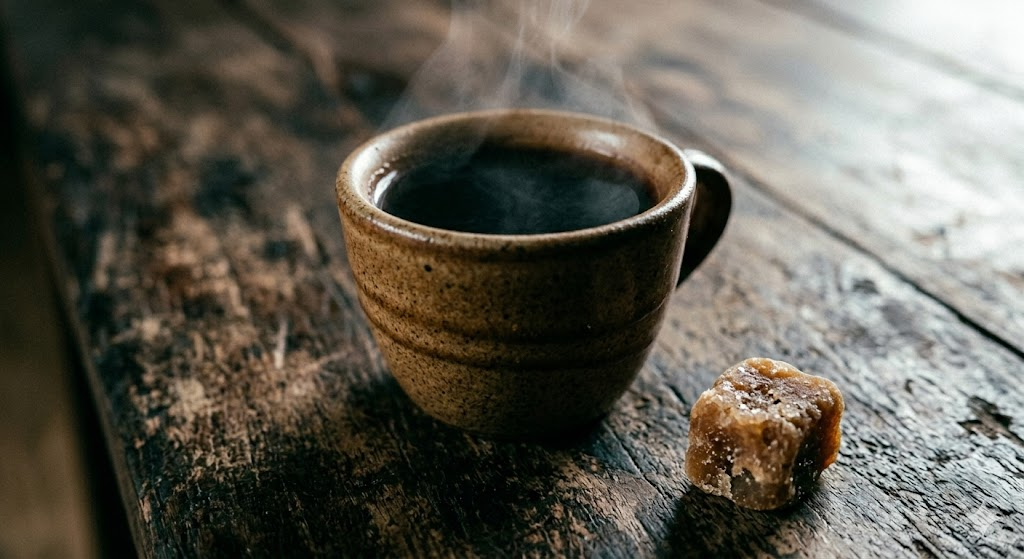
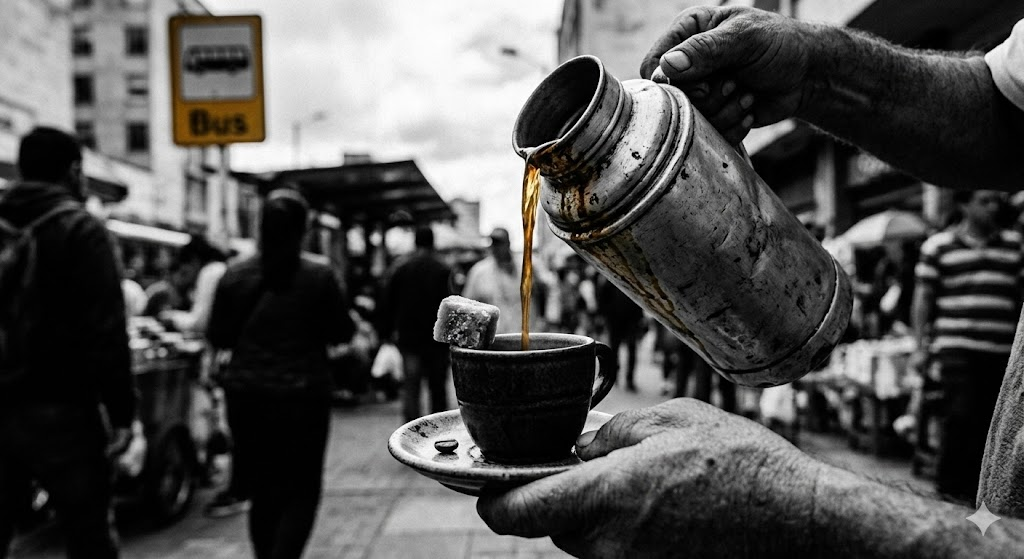
I came back from a week in Bogotá with three kilos of green Caturra in my luggage, a notebook full of brew ratios scrawled in the margins of a coffee shop receipt, and a genuine crisis of identity about whether any of my equipment at home had been worth it. A street vendor on Carrera Séptima handed me a tinto from a thermos he’d been carrying since 5 a.m. It was 11. That coffee had been sitting at somewhere around 170°F for six hours. It was the best thing I’d had all trip. I don’t want to talk about it.
So here’s what I know, what I’ve reverse-engineered at home, and what you should understand about Colombian Tinto coffee before you ruin it by trying to improve it.
What Colombian Tinto Coffee Actually Is (And What It Isn’t)
First, the etymology, because people get this wrong constantly. Tinto in most Spanish-speaking countries means red wine. In Colombia, it means black coffee — specifically a small, dark, unsweetened-or-lightly-sweetened black coffee served in a small ceramic cup called a pocillo. Not espresso. Not a lungo. Not a “Colombian drip coffee” with the airquotes. It’s its own category. The TDS isn’t measured. The extraction yield isn’t discussed. Your Atago refractometer stays in the drawer.
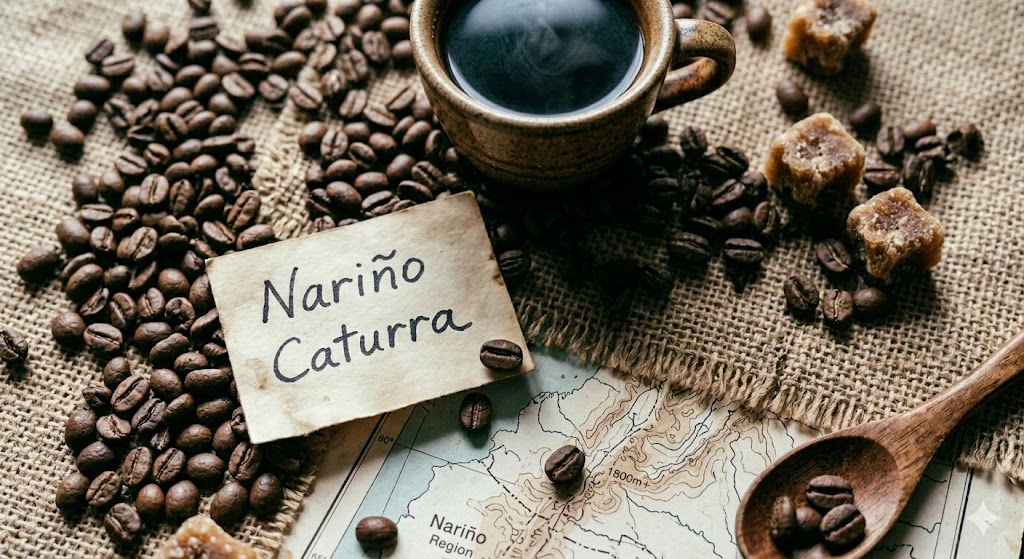
The beans are typically a Colombian Arabica — Caturra, Castillo, or Colombia variety — grown at altitude between 1,200 and 2,000 meters, where the combination of volcanic soil, shade cover, and the bimodal rainy season produces a cherry with a density and sugar content that makes the Maillard reaction during roasting do something genuinely interesting. The roast profile for traditional tinto is medium to medium-dark. Not the third-wave light roast that tastes like strawberry jam dissolved in warm water. A real roast. Brown. With some development time post-crack so the sugars have actually done something.
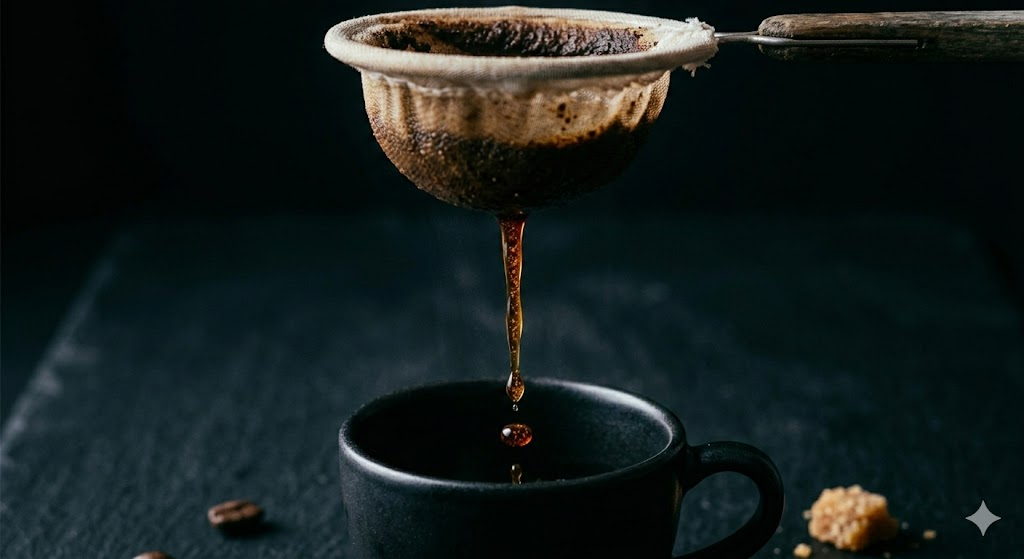
The grind is medium-coarse. The brew method is a colador — a cloth or fine-mesh sock strainer that Colombians have been using since before paper filters existed, and which, critically, does not strip the coffee of its oils the way a Melitta cone does. Those oils matter. They carry volatile aromatic compounds and they contribute to mouthfeel in a way that makes Colombian Tinto coffee feel substantial rather than watery even at a relatively restrained brew strength. You want those monoglycerides in your cup. They belong there.
The Only Cup I Haven’t Apologized For
I’ve been making Colombian Tinto coffee at home for about eight months now with obsessive, slightly embarrassing dedication. (My partner has started leaving the kitchen when I begin the grind. I understand. I respect it.) The version I’ve landed on uses 198°F water — not 201°F, not a full boil, not “just off boil” as a vague directive — because at 198°F the extraction of the medium-dark Colombian roast I’m working with, a Nariño Caturra from a small exporter I found after three weeks of emails that I’m not going to name-drop here, hits its sweet spot without pushing into the bitter phenolic range that you get when you’re careless with heat.
The ratio is 1:13 by weight. Not 1:15. Not 1:16. You’re not making a pour-over for a cupping flight. You’re making tinto. It should be dark enough to mean something.
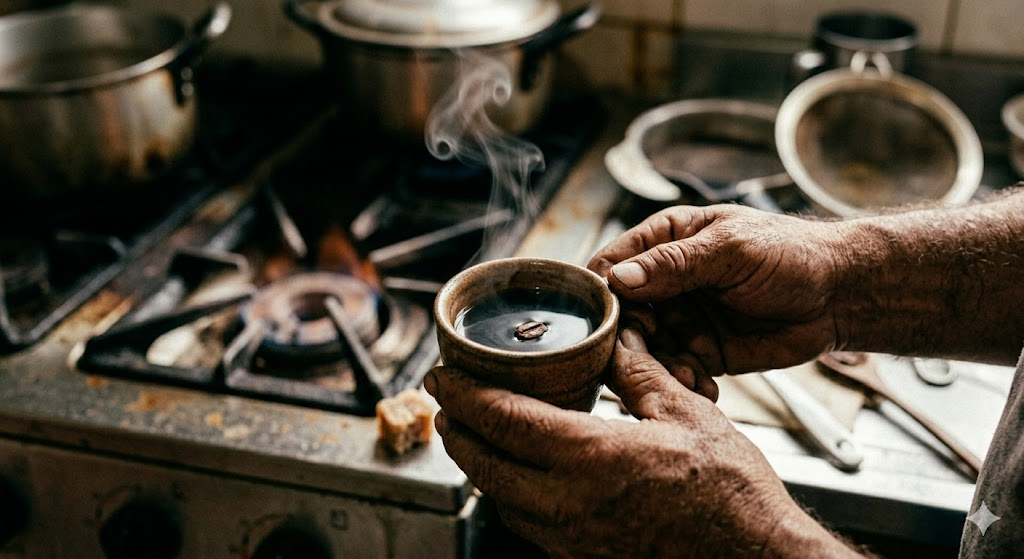
The cloth strainer — I use a nylon mesh colador I found online after discovering that the one I brought back from Colombia had started to develop a faint rancid-lipid film that I couldn’t get off no matter how aggressively I cleaned it (lesson learned: rinse immediately, dry completely, don’t let wet coffee oils sit in fabric overnight) — allows a fine sediment through. There will be sediment. There’s supposed to be sediment. The last few millimeters of your tinto will be slightly viscous and murky, and you leave them. You don’t drink them. You understand what they represent and you move on.
This is not the cup you drink while staring at a laptop. This is the cup you drink while standing at a window or sitting on a step or having a conversation with someone you’re not trying to impress.
Colombian Tinto Coffee Recipe — The Real One
Before we get into the mechanics: the panela. Raw cane sugar, pressed into a block, dried, sold whole at any Latin grocery store worth existing. (The Mercado Latino on Roosevelt, in my case, which is a 22-minute drive but has the only panela blocks in my area that aren’t the pre-grated supermarket version which is fine but texturally wrong — you want to shave or grate your own from a solid block because the surface area oxidizes differently and the molasses notes stay more intact.) You don’t dissolve the panela into the coffee. You put it on the side. You take a small bite. You take a sip. The sweetness distributes in your mouth, not in the cup. This is the method. This is not optional.
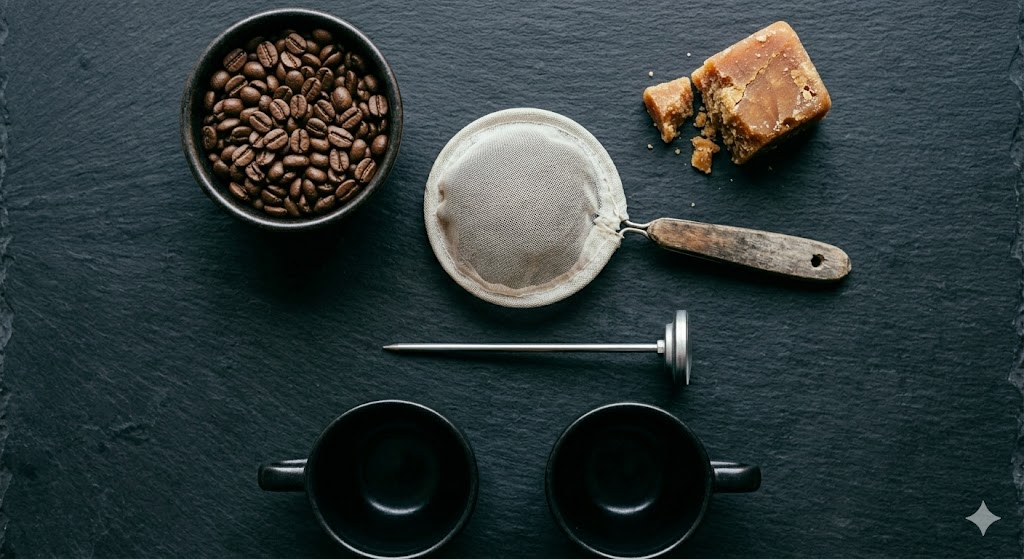
The following makes two small cups — roughly 120ml each. Scale accordingly, but don’t make more than you’ll drink in ten minutes. Colombian Tinto coffee is not a batch-brew situation.
What You Need for Authentic Colombian Tinto Coffee
- 28g freshly ground Colombian Arabica (Caturra or Castillo preferred), medium-dark roast, medium-coarse grind — think coarser than drip, finer than French press, somewhere that a Baratza Encore at setting 18 gets you close to
- 365ml filtered water, heated to 198°F
- A colador — cloth or fine nylon mesh strainer, rinsed clean and slightly damp before use so the fabric doesn’t absorb your first pour
- A small pot or kettle for heating (not your gooseneck; the flow rate doesn’t matter here)
- Two pocillos or small ceramic cups — 120–150ml capacity, pre-warmed
- One block of raw panela (piloncillo works as a substitute if that’s what your store has)
- A small grater or sharp knife for shaving the panela
The Process — No Theater Required
- Pre-warm your cups. Pour a small amount of hot water into each pocillo. Leave it there while you brew. A cold cup drops your coffee temperature by 8–12°F on contact. You did not heat your water to 198°F to serve it at 185°F.
- Position your colador over a heat-safe vessel — a small pitcher, a measuring cup, whatever you have. The colador should be rinsed with hot water first. A dry cloth strainer will steal your first 30ml of brew via absorption and you’ll wonder why the yield is short.
- Add your ground coffee to the colador. 28 grams. Shake it level. Do not tamp. This isn’t espresso. The resistance should come from the grind size, not compression.
- Pour slowly and deliberately. Start in the center. Work outward in a loose spiral. You’re not blooming — this isn’t a pour-over, and the CO2 off-gassing from a medium-dark roast at this grind size through this mesh is not a factor worth worrying about. Just pour at a steady pace. The whole 365ml should take about 90 seconds to add. Total brew time from first pour to final drip: approximately 3 to 3.5 minutes. If it’s running faster than 2.5 minutes, your grind is too coarse. If it’s stalling past 4 minutes, too fine. Adjust. (It’ll take you two or three batches to dial in. That’s the job.)
- Discard the hot water from your pocillos. Pour the brewed Colombian Tinto coffee immediately. You should have roughly 300ml of finished coffee — 150ml per cup, slightly reduced from your water input due to absorption in the grounds and the cloth.
- Serve with panela on the side. A small shard or a light grating of the raw cane block. Not in the cup. On the saucer, or just placed beside it on the table. The ratio of how much you use is personal and generational and none of my business.
On the Temperature Window for Colombian Tinto Coffee
Drink it within eight minutes. The aromatic top notes — the citric brightness, the mild floral volatiles that make a good Nariño or Huila bean actually interesting — begin dissipating almost immediately as the surface cools. What you’re left with after fifteen minutes is still drinkable but it’s heavier, the phenolic bitterness moves forward in the profile, and the pleasant acidity flattens into something dull. The Colombian street vendor with his thermos has been in this game long enough to know that his tinto is past its volatile peak — he compensates with more panela. You, at home, with fresh beans and an actual thermometer, do not need to make that accommodation. Drink it while it’s saying something.
Why the Colador Beats Your Paper Filter (And You Should Be Embarrassed)
There’s a reason research on coffee lipid content keeps circling back to brew method as the primary variable. Paper filtration strips cafestol and kahweol — the diterpenes responsible for a significant portion of what gives unfiltered coffee its mouthfeel and its perceived body — down to essentially zero. A cloth or metal filter retains them. The cup you get from a colador has a viscosity that a Chemex output simply cannot replicate, not because Chemex is badly designed (it isn’t), but because the paper is doing exactly what it was engineered to do: aggressive particulate and lipid removal. That’s a choice that was made for you without your consent decades ago by a filtration culture that prized clarity over character. Colombian Tinto coffee never made that choice. The oils stayed in the cup. The body stayed in the cup. The sediment stayed in the cup (the last bit, anyway — don’t drink the last bit).
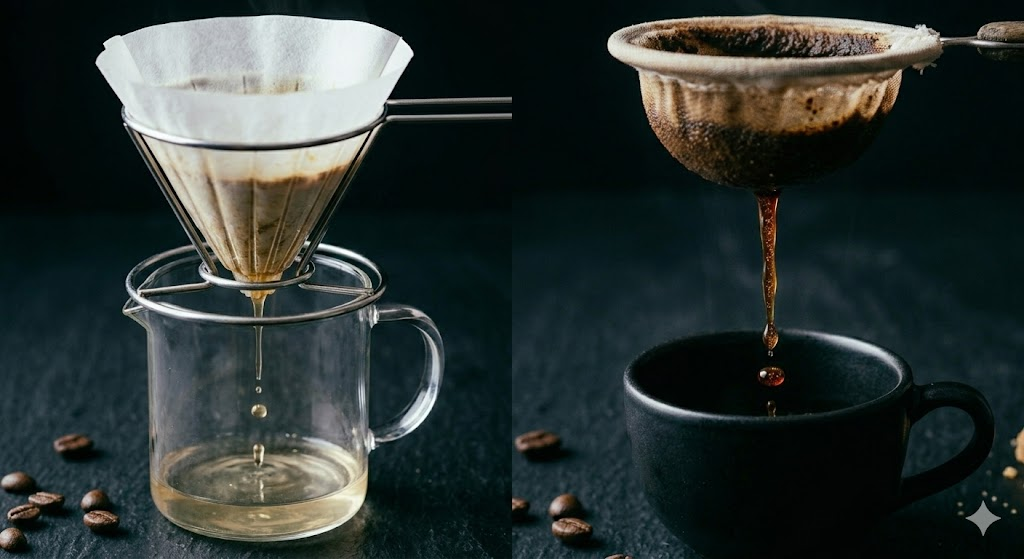
For anyone skeptical of this, the NCA’s brewing guidelines acknowledge that brew method fundamentally alters chemical composition of the final cup — not just strength or flavor perception, but actual molecular content. A tinto brewed through a colador is a chemically different beverage than the same beans through a paper cone at the same ratio and temperature. Different. Not weaker. Not stronger. Different.
The cloth strainer requires maintenance. Rinse immediately after every use. Do not let coffee grounds sit in it. Do not put it away wet. A colador that’s been left to dry with residual grounds develops a rancid-lipid coating on the fabric that will make every subsequent cup taste like the inside of a forgotten thermos. You will blame the beans. The beans are innocent.
What the Beans Actually Are — And Why the Altitude Number Matters
Colombian coffee growing regions are not interchangeable. The Federación Nacional de Cafeteros has spent the better part of a century cataloguing the regional profiles, and the differences are real enough that a careful palate can distinguish Huila from Antioquia from Sierra Nevada without a label. For Colombian Tinto coffee made at home, you want beans from the southern departments — Huila, Nariño, Cauca — where altitude runs higher and the flavor profiles tend toward a cleaner, more defined cup with better natural acidity and what roasters describe as “stone fruit” notes before the roast development moves them into the brown-sugar, caramel range that the medium-dark roast for tinto requires.
Buy whole bean. Grind immediately before brewing. This is not precious advice from a gear-head — this is chemistry. Ground coffee begins losing volatile aromatics within minutes of grind exposure. The cell structure ruptures, CO2 starts venting, and the aromatic compounds that make a high-altitude Colombian interesting begin oxidizing. The Colombian grandmother brewing tinto on a gas burner in Medellín has her coffee in a whole-bean state until the moment she needs it. This is why it tastes better than what you’ve been making with the pre-ground stuff from the supermarket shelf.
The roast level: medium-dark. I want to be precise about what this means because “medium-dark” is routinely abused as a label. You’re looking for a roast that has cleared second crack by a few seconds — not deeply into it, not a French roast, not a roast where the oils are visibly beading on the surface of every bean like the coffee is sweating with shame. Surface should be dry to slightly tacky. Color should be a deep mahogany-brown, not black. At this development level, the sugars have undergone sufficient Maillard browning to produce the caramel and nutty notes associated with traditional tinto, while retaining enough of the bean’s origin character to remind you that what you’re drinking came from somewhere specific at significant elevation.
Industrial Sludge for the Masses (A Two-Sentence Dismissal)
If you’ve been making “Colombian coffee” from a can with a picture of a man on a mule, what you’ve been drinking is pre-ground commodity Arabica blended for shelf stability and supermarket pricing, roasted dark enough to obliterate any regional character, and sitting in oxidized mediocrity for however many months it took to get from the roaster to your cabinet. It tastes like a wet paper bag that briefly knew a coffee bean, and you deserve better — which is why Colombian Tinto coffee exists, and why you should make it correctly.
The Panela Situation, Explained Once
Panela — called piloncillo in Mexico, rapadura in Brazil, jaggery across South and Southeast Asia — is unrefined whole cane sugar. The juice is extracted from the cane, heated, and poured into molds to solidify. Nothing is separated out. The molasses stays in. The trace minerals stay in. The result is a block of sugar that has actual flavor rather than just sweetness — notes of rum, smoke, dried fruit, and something vaguely mineral that plays against the caramel bitterness of a properly brewed Colombian Tinto coffee in a way that refined white sugar cannot approximate regardless of quantity.
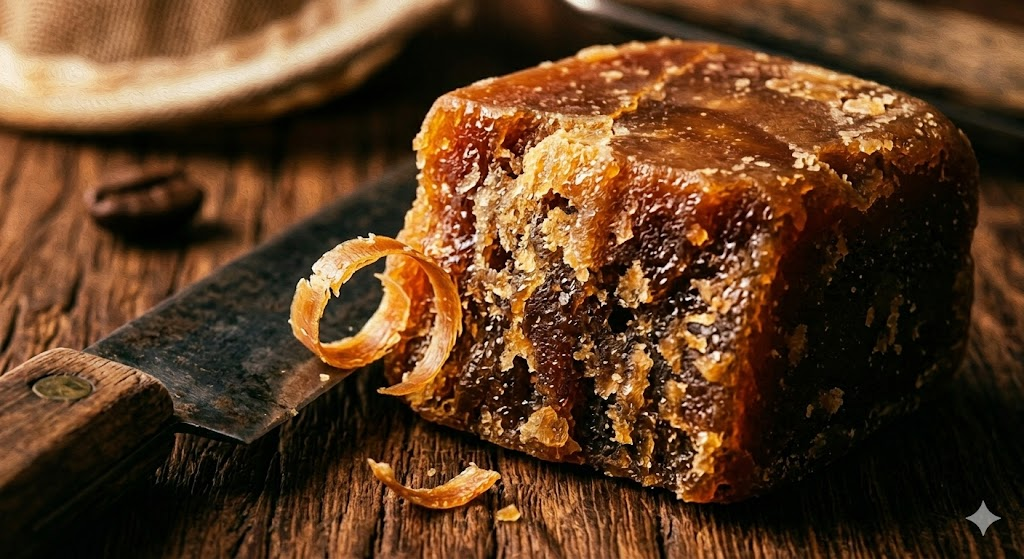
You don’t need much. A small shaving — maybe three or four grams — bitten between sips rather than dissolved, allows you to modulate the sweetness perception without altering the chemistry of the cup itself. The coffee stays black. The panela stays solid. The sweetness lives in your mouth, not your cup. This is the correct approach and there is, in my experience, no meaningful counterargument.
If you cannot find panela at a Latin grocery store (unlikely in most mid-sized American cities, but not impossible), raw turbinado sugar dissolved into a light syrup is the closest approximation. Muscovado sugar, loosely packed, also works in a pinch. White sugar dissolved into the cup is technically functional and also pointless.
A Few Things That Will Ruin Your Colombian Tinto Coffee
Pre-grinding your beans the night before. Using water from a tap with significant chloramine content without filtering it first — chloramines don’t cook off the way free chlorine does, and they will put a chalky, faintly antiseptic edge on the finish of your cup that you’ll blame on the roast level or the grind size and never find the actual cause of. Brewing into a cold vessel. Using a paper filter because you don’t feel like cleaning the colador. Making more than you’ll drink in the next ten minutes. Adding milk. (Milk is not the enemy in general, but milk in Colombian Tinto coffee is a different drink with a different name — café con leche — and should be acknowledged as such rather than pretended to be the same thing in a different ratio.)
Also: storing your beans in the freezer in a container that isn’t genuinely airtight is worse than just leaving them on the counter in a good ceramic canister. The freeze-thaw cycle with any moisture infiltration accelerates oxidation in ways that a thermally stable room temperature environment doesn’t. Unless you’re buying in bulk (more than 500g at a time) and sealing individual doses in vacuum bags before freezing, leave the beans at room temperature in a sealed container away from light, and use them within three weeks of the roast date. The roast date should be printed on the bag. If it isn’t, the roaster is hiding something.
The Colombian Tinto Coffee Verdict
Colombian Tinto coffee is the most honest argument against gear culture I have ever encountered in liquid form. It requires a cloth strainer that costs four dollars, beans from a country that has been growing excellent Arabica at altitude for over a century, water at a temperature you can measure with a two-dollar thermometer, and a block of raw cane sugar that you put on the side and do not dissolve. The cup is small. The ritual is brief. The result, when you’ve dialed in the grind and the ratio and you’re using beans that were roasted within the last two weeks, is something with genuine character — not smooth, not balanced in the anodyne third-wave sense, but present. Alive. Tasting like it came from a specific latitude and a specific elevation and a specific set of decisions made by a farmer who knew what they were doing.
Everything else you own is optional. This is not.
For more on Colombian coffee culture and regional growing profiles, see the Federación Nacional de Cafeteros de Colombia. For brewing science and extraction research, the Specialty Coffee Association’s research archive is worth your time. For panela sourcing and Latin pantry staples, find your nearest Latin grocery — they have it, and it costs almost nothing.