
The Café Du Monde chicory coffee recipe is not a recipe. That’s the first thing you need to understand before you touch a single gram of anything. It’s a doctrine. It’s what happens when a French colonial city grafted itself onto a bayou and spent two hundred years refusing to apologize for anything it put in a cup. You either respect that or you drink your watery single-origin pour-over in peace and leave the rest of us alone.
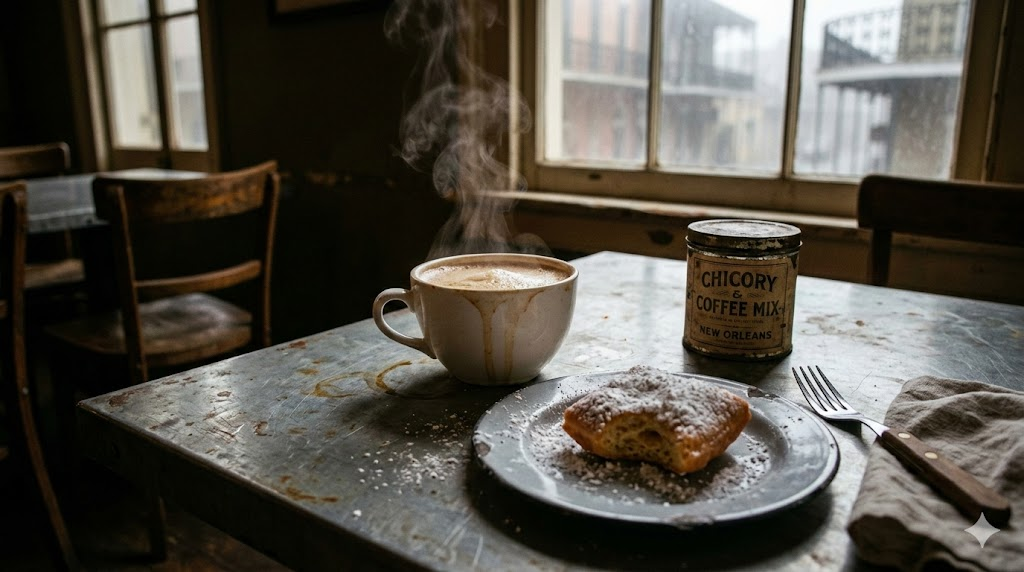
I’ve been chasing this cup for eleven years. I have a shelf above my espresso machine that my partner refers to as “the museum of bad decisions” — four different chicory blends, two stovetop moka pots, a Vietnamese phin filter I bought on a trip to Houston, and a French press I keep around purely to remind myself why I don’t use French presses. Every single one of those objects was purchased in service of replicating what a paper cup of café au lait from a green-and-white awning on Decatur Street tastes like at 2 a.m., when the street smells like river mud and burnt sugar and somebody’s saxophone.
This is the article I wish existed when I started. It is not gentle.
Why Your Version of the Café Du Monde Chicory Coffee Recipe Tastes Like Regret
Most home attempts at the Café Du Monde chicory coffee recipe fail at the first step, which is acquisition. People order a can of Café Du Monde’s own canned chicory blend — fine, correct move — and then they proceed to treat it like it’s Folgers. They scoop it into a flat-bottomed drip machine, run municipal tap water at whatever temperature the heating element decides is sufficient, and wonder why the output tastes like a photocopy of a memory.
Here’s what’s happening chemically: chicory root (Cichorium intybus) contributes inulin, a fructan polymer that behaves nothing like coffee’s suite of chlorogenic acids and caffeine. When you under-extract chicory, you get a thin, vaguely earthy liquid with a bitterness that’s hollow rather than structured. When you over-extract it, you get something tannic and viscous, a lipid-film situation coating your tongue that no amount of hot milk corrects. The window is narrow. The Maillard reaction products in roasted chicory caramelize at a different rate than coffee’s, which means your drip machine’s 195°F default brew temperature is almost certainly wrong for this specific blend.
(I once did a side-by-side at 195°F versus 205°F using the same Café Du Monde blend and a Stagg EKG with a thermometer probe taped to the brew head. The 205°F cup had measurably higher TDS — I was running a VST refractometer at the time — and the chicory character was rounder, less scratchy at the finish. Nobody asked me to do this. My notes from that session are seventeen pages long.)
The Only Brewing Method That Doesn’t Embarrass the Blend
The traditional New Orleans drip is a slow, gravity-fed process. Café Du Monde’s beignet stall uses large commercial drip urns running at volume, which means the coffee is always relatively fresh, always hot, always brewed at a rate that doesn’t allow the grounds to sit and bitter-steep. Your home drip machine does not replicate this. What it replicates is a polite suggestion of the concept.
The method that actually works — the one that gets you a cup that makes you stop talking mid-sentence — is a modified Vietnamese phin filter approach, because the slow, gravity-controlled drip through a relatively coarse grind gives the chicory and coffee time to marry without over-extracting the chicory’s more aggressive bitter compounds. You can also achieve this with a slow-pour Chemex, but the paper filter strips some of the heavier oils that give the Café Du Monde chicory coffee recipe its characteristic body. You want those oils. They’re part of the architecture of the cup.
The chicory-to-coffee ratio at Café Du Monde is approximately 30% chicory to 70% coffee by weight — though some sources say the commercial blend is closer to 35/65. The canned product handles this for you, but if you’re blending your own, get a scale. Not a volumetric tablespoon measure. A scale. Chicory is denser than coffee grounds in ways that make volumetric measurement a comedy of errors.
Café Du Monde Chicory Coffee Recipe: The Actual Method
Serves 2 | Prep: 5 min | Brew: 8–10 min | Total: ~15 min
What You Need
- 28g Café Du Monde Coffee & Chicory blend (or equivalent dark-roast chicory blend)
- 360ml filtered water, heated to 203–205°F (not a suggestion)
- 240ml whole milk or half-and-half (scalded, not boiled — there is a difference)
- Sweetener to taste — sugar, not artificial sweetener, not stevia, not monk fruit; this isn’t a wellness blog
- A phin filter, Chemex with a 30% open-flow pre-wet filter, or a high-quality drip machine with temperature control (the Technivorm Moccamaster or the Breville Precision Brewer are the only two home machines I don’t hate)
What You Do
- Heat your water. Use filtered water with a moderate mineral content — somewhere around 75–150 ppm TDS is ideal. Zero-TDS distilled water extracts flat and acrid. Water above 200 ppm TDS tastes like geology. Get an inexpensive TDS meter if you care, which you should, because you’re reading a 2,500-word article about chicory coffee.
- Pre-wet the filter or phin. Pour a small amount of your 203°F water through the empty filter and discard. This removes paper taste and pre-heats the vessel. If you’re using a phin, let the metal absorb heat for thirty seconds before loading grounds.
- Dose the grounds. 28g of the Café Du Monde blend for 360ml of water gives you approximately a 1:12.8 ratio. This is slightly stronger than a standard drip because the chicory needs extraction mass. Grind is medium-coarse if you’re buying whole bean and grinding down — not that the canned pre-ground gives you that option, but context matters.
- Bloom. Add 60ml of water to the grounds and wait 30–45 seconds. The chicory will not produce the dramatic CO₂ bloom that fresh coffee does — it’s a roasted root, not a seed — but this pre-wet step still improves evenness of extraction. You’ll see a slow, tacky expansion rather than a dome. That’s correct.
- Pour in controlled pulses. Add remaining water in three pours of approximately 100ml each, spaced 90 seconds apart. Maintain a slow, center-focused pour. The total brew time from first bloom pour to final drip should be 7–9 minutes. Much faster and you’re under-extracting the chicory. Much slower and it turns bitter in a way that not even the milk will fix.
- Scald the milk. In a small saucepan, heat whole milk or half-and-half to 150–155°F. You want steam wisps, not a rolling bubble. Boiled milk breaks the casein proteins and you get a chalky, flat mouthfeel that ruins the whole exercise. A kitchen thermometer costs eight dollars. Use one.
- Combine 1:1 in a warmed cup. The classic café au lait ratio is equal parts brewed chicory coffee to scalded milk. Some people go 60/40 coffee to milk. Fewer go 40/60. All of these are defensible positions. Going beyond that in either direction is not defensible.
- Sweeten while hot. Sugar dissolves into hot liquid. This is physics.
The Only Variant Worth Mentioning
For iced café au lait: brew the chicory coffee at a 1:8 ratio (stronger concentrate), let it cool to room temperature — do not refrigerate while hot, or you accelerate oxidation and the cup turns musty — then pour over ice with cold whole milk. Cold milk, not scalded. The temperature contrast is the point. Do not use cream; the lipid content is too high and you get an unpleasant monoglyceride suspension on the surface of your ice.
Café Du Monde Chicory Coffee Recipe: What the Can Won’t Tell You
There are five things on that green and gold can that require translation.
First: the grind is medium, not fine. People see “drip” on the label and reach for their espresso grinder setting. The resulting chalky sediment at the bottom of your cup is not artisanal. It’s a mistake.
Second: this coffee goes stale faster than you think. The chicory root is hygroscopic — it absorbs ambient moisture aggressively. Once you open the can, the clock is running. Use a proper airtight canister, not the plastic lid that comes with the tin. I keep mine in a Weck glass jar with a rubber gasket. (I have six of them. Three for coffee, one for tea, one for dehydrated mushrooms, and one that I’m pretty sure has been empty for two years but I haven’t dealt with it yet.)
Third: the roast is dark, and that darkness is load-bearing. The French-style dark roast that goes into authentic Café Du Monde chicory coffee is not a preference — it’s what allows the chicory’s vegetal earthiness to read as richness rather than bitterness. If you try to replicate this Café Du Monde chicory coffee recipe with a medium-roast Ethiopian single-origin and chicory, what you’ll get is a confused cup where the bright, fruity acids fight the inulin bitterness and neither wins. The whole point of dark roast here is that the Maillard and pyrolysis products of the roast suppress the brighter top notes and let the chicory’s caramel-molasses qualities come forward.
Fourth: water temperature is not optional. I’ve already said 203–205°F. I will say it again. Every degree below 200°F drops your chicory extraction efficiency. At 195°F — which is what most cheap drip machines achieve — you are leaving the best parts of the Café Du Monde chicory coffee recipe in the grounds. You are brewing ghost coffee.
Fifth: the milk matters as much as the coffee. This is a café au lait culture. The milk is not an addition; it is a co-equal ingredient. Ultra-pasteurized milk — the kind with the six-month shelf life that you find at the back of the shelf — has a subtly cooked, flat flavor profile that undercuts the chicory’s earthiness. Buy fresh whole milk. Scald it properly. Respect the dairy.
Where the Café Du Monde Chicory Coffee Recipe Goes Wrong for Advanced Drinkers
Let me address the obsessives in the room, because they’re making their own mistakes, just more expensive ones.
The cold brew path: cold brew with chicory sounds logical. Long extraction, low temperature, smooth result — right? Wrong. A cold brew concentrate that’s been oxidizing for 12 hours on a kitchen counter produces a manganese-bitter, almost medicinal liquid from chicory that bears zero resemblance to what you’re trying to replicate. The flash-chilled Japanese method — brewing hot directly over ice — gets you much closer to the iced café au lait character without the oxidation problem. Brew at 1:8 ratio, hot, and pour immediately over ice in a metal vessel. The thermal shock locks in volatile aromatic compounds before they dissipate.
The espresso path: yes, you can pull a concentrated chicory-coffee shot through an espresso machine. No, it doesn’t taste like a smaller, more intense version of the drip. The 9-bar pressure extraction fundamentally changes the compound profile you’re pulling from the chicory. You get more of the bitter phenolic compounds and less of the sweet inulin-caramel character. What you get is technically interesting and categorically wrong for this application.
The French press path: the French press gives you maximum oil content and zero paper-filter interference. It also, with chicory, gives you a sediment situation at the bottom of the cup that has the consistency of wet creek mud, because chicory particles are smaller and lighter than coffee particles and they blow through the metal mesh filter. You will drink grit. (I tried a cloth filter insert in the French press once. It works, but cleaning it involves standing over a sink for four minutes scraping chicory paste out of linen with a spatula, which is not how I want to start my morning.)
A Note on Chicory Blends That Aren’t Café Du Monde
Community Coffee’s Café Special dark roast with chicory is the only other mass-market blend that gets close. Different roast profile — slightly less charred at the edges, a bit more fruity residue in the cup — but structurally similar enough that the method above works without adjustment. The French Market brand is acceptable in the way that a Holiday Inn is acceptable: functional, predictable, and you’d never choose it if there were an alternative available.
Everything else I’ve tried — various artisan roasters doing “New Orleans style” blends, the chicory-forward bags from specialty shops that cost fourteen dollars for eight ounces — has either gotten the ratio wrong, used a chicory source that’s too coarsely cut (which under-extracts), or roasted the coffee too light and called it “nuanced.” Nuance is not what you want from a Café Du Monde chicory coffee recipe. You want the liquid equivalent of a brass band on a Sunday morning in the Marigny: loud, warm, slightly overwhelming, and completely right.
The Equipment I Actually Use for This Café Du Monde Chicory Coffee Recipe
Since people always ask: I use a temperature-controlled drip brewer set to 204°F when I’m brewing at volume. When I’m doing a single cup, it’s a Vietnamese phin — the 4-ounce size, stainless steel, nothing fancy. The phin gives me control over contact time in a way that even the best home drip machine can’t. I time every pour with my phone. Not because I’m precious about it, but because eleven years of inconsistent cups taught me that the only variable I can truly control is time, and that control is worth the thirty seconds it costs me.
For milk: a small saucepan on medium-low, a clip-on thermometer, and whatever whole milk came from within the last five days. I take it off heat at 153°F because it carries over to 155°F in the pan. If I’m in a hotel room or somewhere without a stove, I heat milk in a mug in the microwave in thirty-second increments and check temperature with a pocket thermometer I carry in my bag. (Yes, I carry a pocket thermometer. Somewhere around year four of this obsession, this stopped feeling strange.)
For water: a Brita pitcher with a fresh filter, run-of-tap from wherever I am. Nothing exotic. The Brita catches most of the chlorine that would otherwise interfere with the cleaner aromatic compounds in the chicory extract, and it brings most municipal water into an acceptable TDS range. If you want to go further, Third Wave Water minerals added to distilled will get you a precisely profiled extraction water. I do this for espresso. For chicory drip, the Brita is enough.
What It Should Actually Taste Like When You Get It Right
When this Café Du Monde chicory coffee recipe works — and it does work, when you hold the variables — the cup is dark brown going on mahogany, with a very thin, almost invisible lipid ring at the edge where the milk fat has distributed. The aroma is roasted dark wood and something almost molasses-adjacent, with a faint earthiness that is the chicory and nothing else. It should smell like it’s doing something.
The first sip should hit you warm and immediately. The bitterness is present but it’s round, not sharp — it doesn’t scrape. The milk integrates rather than dilutes; you shouldn’t taste them separately. There’s a finish that lingers somewhere between dark chocolate and toasted grain, and it doesn’t have the sour-acid flash of lighter roasts. The cup is substantial. It has weight. It’s the kind of thing you drink while standing, with both hands around the cup, looking out at something.
If your cup is thin, you under-extracted — lower your ratio or slow your pour. If it’s chalky or tannic at the finish, you over-extracted — coarsen your grind or cool your water by two degrees. If it’s flat and indistinct, your water was wrong or your chicory blend is old. If it tastes like a melted crayon, your milk was ultra-pasteurized and you need to go back to the store.
The Café Du Monde chicory coffee recipe is not complicated. But it is unforgiving of carelessness, which is really just its way of asking you to pay attention. Pay attention. It’s worth it.
“The Creole café au lait is one of the great democratic drinks. It asks nothing of you except that you respect it.”
— Nobody famous. Just something true.