
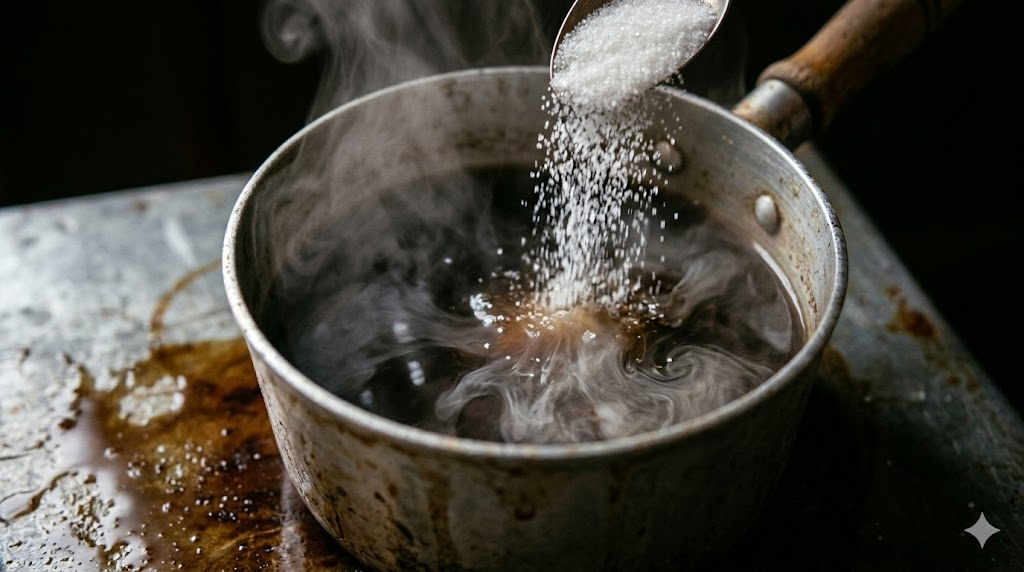
Brazilian Cafezinho is the coffee you didn’t know you needed and the one that makes everything in your Chemex cabinet look like a very expensive hobby for people who are afraid of flavor. I’ve been chasing this cup for three years. Three years of burning my fingers on espresso handles, of arguing with baristas who think “terroir” is something you put on a business card, of waking up at 4 a.m. with too much cortisol and not enough answers. And then I landed in São Paulo, standing in a padaria on Rua Augusta at 7 a.m., watching an older woman named Dona Cida dump sugar directly into the boiling brew water before filtration — and something clicked so hard in my chest I thought I was having a cardiac event.
This wasn’t a recipe. This was a philosophy. A deeply technical, thermodynamically specific, emotionally loaded philosophy that Brazilians execute without a scale, without a gooseneck kettle, and without so much as a glance at a TDS meter. And it’s better than most things I’ve paid $18 for.
Let me tear it apart for you.
What Brazilian Cafezinho Actually Is (And Isn’t)
Brazilian Cafezinho — the word means “little coffee,” which is both accurate and wildly underselling it — is brewed by dissolving sugar directly into water before that water contacts the ground coffee and passes through a cloth or paper filter. No milk. No cream. No oat-based emulsification. It’s served in a demitasse, consumed fast, and repeated throughout the day at intervals that would make a cardiologist nervous. (My resting heart rate during the São Paulo trip hit 94 bpm by day three. I was fine. I think.)
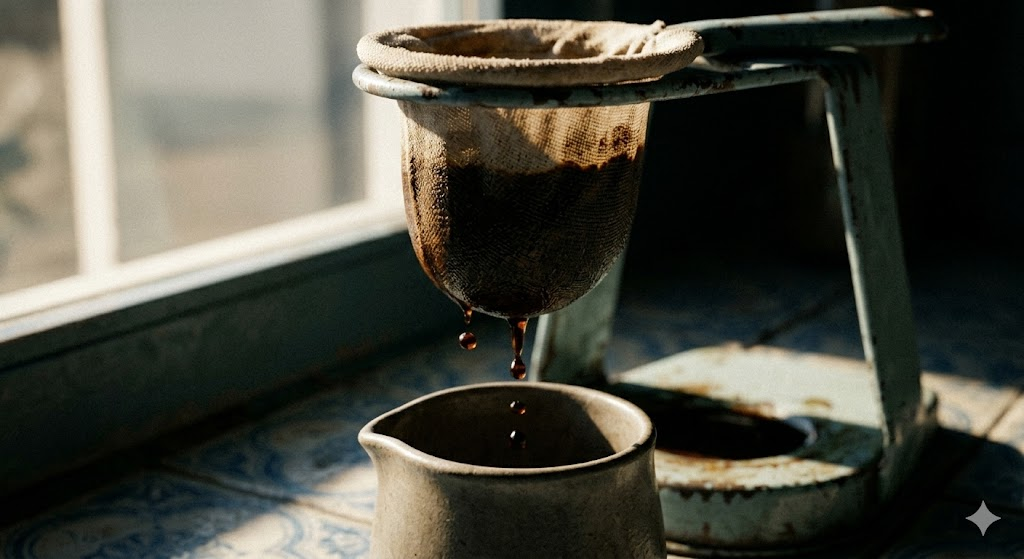
The grain size is critical. We’re talking a grind so fine it walks the line between Turkish and espresso — fine enough that a standard drip basket will pass it through as sediment-heavy sludge. The traditional method uses a cloth sock filter called a coador de pano, which provides a slower, more controlled filtration that strips some of the lipid-film you’d find in a French press while retaining the dense, syrupy mouthfeel that makes Brazilian Cafezinho worth caring about.
If you don’t have a coador, a reusable cloth filter stretched over a ceramic dripper will do. A paper filter in a V60 will work but strips out more oils, leaving you with something brighter and thinner — technically correct, spiritually wrong.
The Sugar Goes In First — Yes, Before the Coffee, You Heathen
This is the part where every specialty coffee person in a linen apron has a small breakdown. The sugar isn’t an afterthought stirred in at the end. It’s dissolved into the brew water — typically at around 203°F, just off a rolling boil — before that water interacts with the ground coffee. This matters enormously and I am going to explain why with the caveat that if you already know what sucrose inversion does to extraction kinetics, you can skip ahead. If not: stay.
When sucrose dissolves in hot water pre-extraction, it modifies the polarity of the solution and affects how the water interacts with the coffee’s soluble compounds. The sugar creates a slightly denser liquid matrix. The result is a cup that reads not as “sweet coffee” but as something with a rounder, more viscous body — a different textural experience than sweetening post-brew, where you’re just dumping sucrose on top of an already-set extraction. The Maillard reaction products already present in a dark Brazilian roast interact differently with a pre-sweetened brew water. The bitterness compounds don’t read as sharp. The finish is longer, more integrated.
I’ve run this side by side. Same coffee, same grind, same ratio, same temperature. Sugar-first versus sugar-after. The sugar-first cup is measurably more coherent. Less like coffee-plus-sugar and more like a thing that was always supposed to be this way. (Which it was. Brazilians have been doing this since before anyone in Portland had opinions about it.)
The Brazilian Cafezinho Recipe: Getting the Ratio Right Without a Scale
Here’s the recipe. Written for someone who owns a kitchen scale but understands that Dona Cida doesn’t and hasn’t needed one in 40 years. I’m including weights because that’s how I think, but I’m also including the volumetric approximations she used, because they work.
Ingredients (Makes 2–3 Demitasse Cups)
- 240ml (1 cup) filtered water
- 16–18g finely ground dark-roast Brazilian coffee (e.g., Café Boa Vista or any Sul de Minas single origin; avoid anything marketed as “bright” or “citrus-forward” — those profiles fight the method)
- 2 teaspoons (8–10g) white granulated sugar, or to taste — the traditional measure is 1 heaping teaspoon per demitasse cup served
- 1 cloth coador or reusable cloth filter
Equipment Notes
Your kettle needs to hit 203°F and hold it. If you have a variable-temp kettle, use it. If you’re boiling and letting it sit, that’s fine — give it 30 seconds off the boil in a standard kitchen. Do not obsess over ±2°F here. Brazilian Cafezinho is forgiving of temperature variation in a way that pour-over is not, because the sugar is doing some buffering work in the extraction. The grind consistency matters more than the exact temperature. Get a burr grinder. A blade grinder produces an uneven particle distribution that gives you simultaneous over- and under-extraction — simultaneously chalky and bitter, which is exactly as bad as it sounds.
Method
Step 1: Heat the water. Bring 240ml of filtered water to 203°F — just off boil. If your tap water is heavily chlorinated, filter it. Chlorine compounds will flatten the aromatic volatiles in the cup. This isn’t precious; it’s chemistry.
Step 2: Dissolve the sugar in the hot water. Add your 2 teaspoons of white sugar directly to the heated water and stir until fully dissolved. This takes about 15 seconds. The water should look clear, not turbid. If it looks turbid, you’ve added too much sugar or your water wasn’t hot enough. Dissolved sugar solution is transparent. This matters because undissolved sugar granules will pass through the filter unevenly and create a gritty residue in the cup that coats the bottom like wet sand.
Step 3: Add the coffee and stir. Add your 16–18g of finely ground coffee directly to the sugar-water. Stir once to wet all the grounds. Allow to bloom for 30 seconds. Yes, bloom. Even for this method. The CO2 off-gassing from fresh-roasted beans will push grounds above the liquid and create uneven contact if you skip this. If your coffee doesn’t bloom at all — if the surface stays flat and inert — your coffee is stale. Throw it out and get fresh coffee. (I’ve started buying in 250g increments and freezing in sealed bags. The freeze-thaw data from Barista Hustle supports this approach for beans used within six weeks.)
Step 4: Pour through the cloth filter. Set your coador over your server or directly over your cups. Pour the full brew through slowly, allowing gravity to do the work. Do not press. Do not stir the filter contents. A cloth filter at this grind size will flow slower than paper — allow 90 seconds to 2 minutes for full passage. The resulting liquid should be dark, opaque at depth, with a thin crema-adjacent foam layer at the surface. Not espresso crema — don’t confuse these. This is a surface tension phenomenon from the dissolved sugars and monoglyceride suspension in the brew, not pressurized CO2 extraction.
Step 5: Serve immediately. No resting. No “letting it open up.” Brazilian Cafezinho is a hot, immediate experience. The volatile aromatics — the green and earthy notes that define a Sul de Minas natural process coffee — dissipate fast at serving temperature. Pour and drink. This is not a contemplative sipping situation. This is a 45-second ritual, repeated six times a day, in between conversations that matter.
On the Coffee Itself: Sul de Minas or Go Home
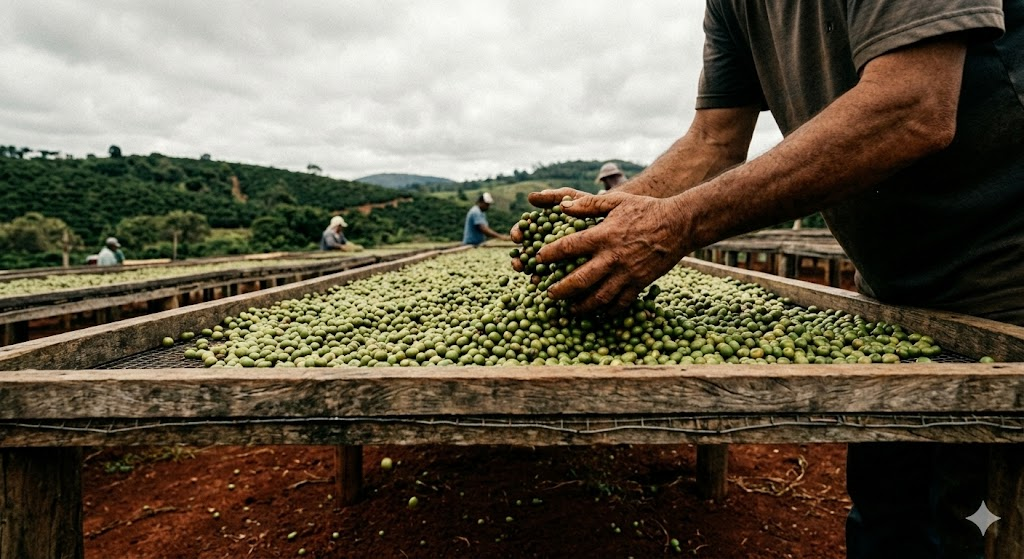
The Brazilian Cafezinho tradition was built on Brazilian coffee — specifically the naturally processed coffees of the Sul de Minas, Cerrado Mineiro, and Mogiana regions. These are not the coffees that win Cup of Excellence in a way that makes international buyers weep into their cupping spoons. They’re rounder. Lower acidity. Naturally processed, which means they were dried on raised beds with the fruit intact, which imparts a heavier body, a wilder fermentation character, and a sweetness that reads as chocolate and dried fig before you’ve even added the sugar.
A Brazilian natural at a medium-dark roast — hitting somewhere around a 55–58 on the Agtron scale — is the correct answer. A light roast Brazilian for Brazilian Cafezinho is technically legal but experientially wrong, like putting Sancerre in a shot glass. (I’ve tried it. The acidity reads sharp against the sucrose and the body is too thin to carry the weight of the brew. Save the light roast Brazilians for your cupping protocols.)
The grind for Brazilian Cafezinho should measure somewhere around 250–350 microns on a proper particle analyzer, though nobody in Brazil is measuring particle size on a Malvern Morphologi. What they are doing is testing the grind against the filter: if it passes through the cloth too fast and the cup is thin and watery, grind finer. If the flow rate is so slow that the brew goes cold in the filter, grind slightly coarser. The cloth filter is your calibration tool.
The Only Version I’ve Made at Home That Didn’t Disappoint Me
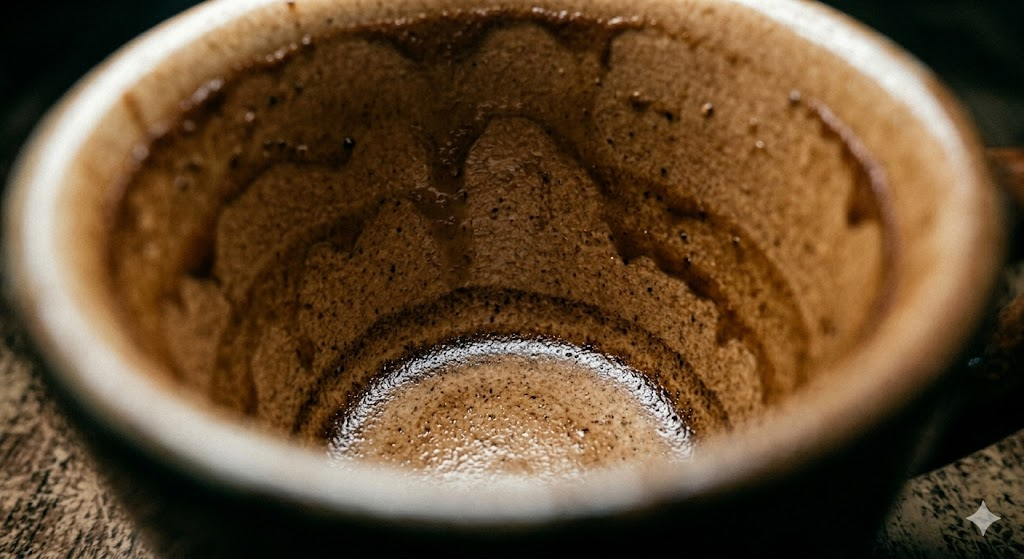
I’ve been using a 1:13 ratio — 18g coffee to 240ml sugar-water — which lands at roughly 1.35% TDS on my refractometer, which is toward the high end of SCAA’s “ideal” extraction window and exactly where Brazilian Cafezinho should live. It’s dense. It coats the inside of the demitasse. When you tip the empty cup, there’s a faint viscous drag along the ceramic wall that tells you the monoglyceride content is right and the extraction wasn’t sloppy.
The coffee I’ve been using is a Fazenda Santa Inês from Carmo de Minas, which — depending on the harvest year — runs floral and full at the same time, like something that grew up in red soil and didn’t apologize for it. (I order it through a specialty importer. The co-op grocery near me stocks exactly three Brazilian coffees, all medium roast blends in sealed plastic pouches that look like they were packed in 2019, and I refuse to use them for this.)
The cloth filter I use is a simple drawstring coador I brought back from São Paulo. You can find equivalent coadores online from Brazilian kitchen suppliers. Rinse it with hot water before use to eliminate any residual fiber smell. After use, rinse with cold water — never soap — and store damp in the refrigerator between uses. A cloth filter develops seasoning over time. The oils from previous brews condition the cloth and subtly influence subsequent extractions. This is either gross or wonderful depending on your relationship with the concept of accumulated flavor.
Bitter Industrial Sludge Masquerading as Cafezinho
I’ve encountered two pretenders to this cup that I want to address briefly, because they’re out there and they’re disappointing people. First: the “Cafezinho kit” sold by a certain multinational coffee brand that shall remain nameless, which consists of a pre-ground medium roast of indeterminate origin in a foil packet with a paper filter insert and printed sugar packets. It tastes like dissolved cardboard sweetened with regret. The TDS is low. The particle grind is coarse. The paper filter strips every lipid compound from the brew leaving a thin, flat, structureless liquid that has nothing in common with the real thing except the name. Second: cold brew concentrate marketed as a “Brazilian coffee experience,” which — I have no words. A cold brew concentrate that’s been oxidizing in a tap-handle keg for 12 hours at 38°F is not cafezinho. It is not anything. It’s a coffee-adjacent beverage for people who want the aesthetic without the caffeine shock.
Brazilian Cafezinho and the Social Architecture Around It
Here’s the thing nobody in the specialty coffee world wants to say because it doesn’t fit the third-wave framework: Brazilian Cafezinho is not primarily about the coffee. It’s about the pause. The cup is the excuse. It appears between meetings, after meals, when someone arrives, when someone leaves. It is the physical manifestation of “we are taking a moment.” The Brazilian relationship with coffee — documented extensively in social anthropology of Brazilian food culture — is relational, not contemplative. You don’t sit with a Brazilian Cafezinho the way you sit with a single-origin pour-over and think about processing methods. You drink it with another person, fast, while talking about something that matters.
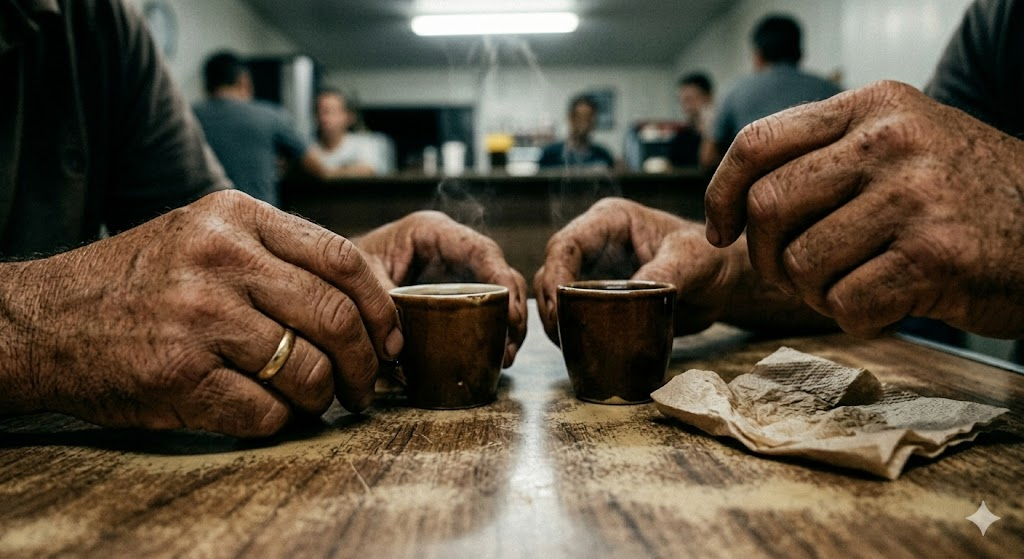
The demitasse size isn’t about limiting consumption. Brazilians drink many of them. The small cup is about immediacy — the drink should be finished while hot, while the volatile aromatics are still present, before the surface cools and the thin crema collapses into a flat, dull surface. A cold cafezinho is a failure of hospitality, and Brazilians treat it as such.
There’s a version of this cup I’ve made on a Tuesday morning at 6 a.m. with nobody else in the kitchen, just the sound of the cloth filter dripping and the sugar-water cooling slightly on the counter. And even alone, it felt correct in a way that a $7 single-origin cortado rarely does. Something about the simplicity of the process — water, sugar, coffee, cloth, heat, time — cuts through the noise of every piece of coffee equipment I’ve accumulated over the past decade. (My Decent Espresso machine cost more than my first car. The cloth coador cost four reais.)
Troubleshooting: When Your Brazilian Cafezinho Tastes Wrong
If the cup is chalky or gritty on the finish: your grind is too fine for your filter, or your filter has a tear. The fine particles are passing through and settling as sediment. Grind 10 microns coarser and check the cloth for holes.
If the cup is thin and watery: grind finer, or increase your dose. At 240ml, you want a minimum of 16g. Going below 14g produces a tea-weak extraction that wastes everyone’s time.
If the cup is aggressively bitter with no sweetness: your water is too hot (above 205°F), your grind is too fine, or your roast is too dark and too stale. A roast date older than four weeks on a dark-roasted natural process Brazilian will produce a hollow, ashy bitterness with nothing underneath it. Fresh coffee. Always fresh coffee.
If the sugar didn’t integrate and you can taste granules: you didn’t stir long enough, or you added the sugar to water that wasn’t hot enough. Sugar dissolves in water at 203°F almost instantly with agitation. If it’s not dissolving, your water isn’t hot enough. Get a thermometer. A basic instant-read works fine — you don’t need a specialty coffee thermometer for this.
If the cup tastes flat and oxidized: your coffee is stale, or you let the brew sit in the filter too long. Brazilian Cafezinho doesn’t wait. The extraction continues as long as the hot brew contacts the spent grounds in the filter. Keep the flow moving. Don’t let it sit.
The Final Argument for Brazilian Cafezinho
Brazilian Cafezinho will not win you a spot in a specialty coffee publication. It doesn’t photograph well in a ceramic flat white cup on a linen surface next to a succulent. It’s dark and small and sweet and direct, and it requires no equipment you don’t already have if you’re willing to buy a four-dollar cloth filter and accept that sometimes the most sophisticated thing you can do is dissolve sugar in hot water and pour it through ground coffee like people have been doing for 200 years in a country that grows more coffee than any other nation on Earth.
Brazil produces roughly 40% of the world’s coffee supply. The people growing that coffee drink Brazilian Cafezinho. Not as a ritual, not as a performance, not as a content opportunity — as coffee. The thing you drink because it’s good, because it’s social, because it marks the beginning and end of things, because Dona Cida on Rua Augusta has been making it the same way since before you were born and she hasn’t read a single brew guide in her life and her cup is better than yours.
Make the Brazilian Cafezinho. Drink it while it’s hot. Don’t take a photo of it.
Related reading: A Guide to Brazil’s Main Coffee Producing Regions | SCA Brewing Protocols | The Science of Freezing Coffee