
Middle Eastern coffee culture dates back centuries and emphasizes hospitality, conversation, and specific preparation rituals.
From Turkish coffee to Arabic qahwa, the region developed distinct brewing methods that shaped the way the world thinks about coffee today. I spent months digging into this history, and honestly, it changed how I look at my morning cup. Let me share what I found.
Where Did Coffee Come From?
According to legend, a goat herder in Ethiopia noticed something strange about his flock. They were getting sudden bursts of energy after eating the coffee shrub’s small red fruit. He tried it himself, and before long, word spread about the natural energy-giving properties of these little cherries. Probably should have led with this, honestly — it’s a great story.
Nobody knows the whole truth behind coffee’s origins. What we do know is that coffee went through a fascinating evolution before it became the dried roasted beans we pick up at the grocery store. The journey is wilder than most people realize.
Early preparations were nothing like what we’d recognize today. Beans were once blended with animal fat and pressed into an early version of an energy bar. The entire fruit — beans, pulp, and hull — was brewed into a kind of tea-like beverage. It took centuries of experimentation before anyone thought to roast just the bean.
That turning point came around the 1200s, when people began roasting coffee beans over fire. From there, the drink we know started to take shape.
Middle Eastern Coffee History
In my experience, the history of Middle Eastern coffee is one of those topics where the deeper you dig, the more interesting it gets. Around the 1200s, Muslims in the Middle East began drying and boiling coffee beans specifically to stay alert during lengthy prayer sessions. That’s a practical origin story if there ever was one.
Coffee stayed contained within Middle Eastern culture for roughly 400 years — a remarkable stretch of time when you think about it. It wasn’t until the 1600s that a pilgrim named Baba Budan, on his way back from Mecca, tucked seven beans inside his robes and carried them to Europe. Seven beans. That’s all it took to change the beverage landscape of an entire continent.
The Dutch became the first Europeans to grow their own coffee, establishing plantations in Sri Lanka. Things snowballed quickly from there. The French took it to the Caribbean, the Portuguese planted it in Brazil, and the Spanish spread it across Central America. European cafes started popping up everywhere, with France and Italy becoming the early standard-bearers for café culture.
Middle Eastern Coffee Culture

Image Source: Rawpixel
Coffee had spread all over Arabia by the 15th century — Yemen, Turkey, Syria, Persia. People gathered in public cafes to drink it, play chess, watch performances, and do what humans have always done best: talk. That’s what makes Arab coffee culture so endearing to us enthusiasts. It was never really about the coffee alone. The drink was just the reason to sit down together.
Brewing methods shifted from place to place, too. Walk into a cafe in the Middle East and you might watch them roast beans right in front of you and grind them on the spot. The coffee often gets brewed with cinnamon, saffron, or cloves. Dates, nuts, or candied fruit show up on the side to soften the intensity. It’s a whole sensory experience.
Normally, Arabic coffee is served in small pours, and the host keeps refilling the cup as long as you want more. I find this tradition genuinely charming — there’s no rush, no timer running down. You drink at your own pace.
Each country adds its own wrinkle. Egyptian coffee comes with a foam layer on top. Lebanese coffee skips the foam entirely. In Yemen, lighter beans are common, often ground with cinnamon, saffron, or cardamom to punch up the flavor.
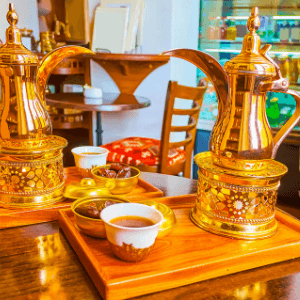
In the UAE, the specialty coffee movement has really taken hold. Modern cafes there source from the best farms globally, roast with obsessive precision, and aim to make every visit memorable. Coffee consumption has nearly doubled in recent years, which tracks — once you experience that level of care, it’s hard to go back.
Saudi Arabia treats coffee as a symbol of hospitality, full stop. Every host offers guests a cup, almost always with a plate of sweet dates alongside. There are traditional ways this plays out at social events: the host or youngest person present holds the coffee pot in their left hand and serves cups using only the right hand. Using the left to hand something over is considered rude — a small detail that carries real weight in Saudi culture.
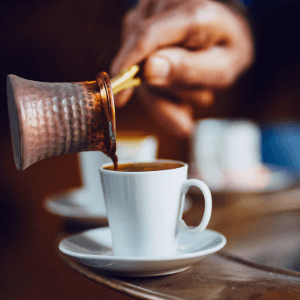
Turkish coffee has fanatics all over the world, and I get it. In Turkey, coffee is ground to a fine powder — either with a grinder or the old-fashioned mortar and pestle — then simmered slowly in milk or water.
Sugar goes in before the heat does its work, and then you leave it alone on low to moderate heat until a foam develops. Absolutely no stirring allowed at this stage. When it’s just about to boil, you pull it off the heat and pour it into cups. The quality of a Turkish coffee is judged almost entirely by that foam. No foam, no glory.
Different Techniques for Different Countries
It’s a little unfair to lump all Middle Eastern countries into one coffee category. The history of coffee in this region is shared, but each country developed its own distinct customs around serving and preparing it. The traditions genuinely differ in meaningful ways.
The one thread running through all of them, though, is hospitality. Coffee is an invitation. It says: sit down, you are welcome here. That meaning has spread worldwide, and I find it comforting that an offer to join someone for coffee carries that same warmth regardless of where you are — even if what ends up in your cup looks nothing like what you expected.
Featured image source: Rawpixel
Coffee History Guides
The Bottom Line
After going deep on Middle Eastern coffee history, here’s what stuck with me: the rituals matter as much as the drink itself. The specifics of how cups are poured, who serves, which hand is used — these aren’t arbitrary rules. They carry real meaning about respect and welcome.
If you ever get the chance to experience authentic Arabic or Turkish coffee prepared traditionally, take it. Reading about the foam on Turkish coffee is one thing. Watching someone nail it and then hand you a tiny cup to taste is something else entirely. Coffee rewards curiosity — especially when you follow it back to where it all started.