
Café de Olla is not a “cozy winter drink.” It is not “rustic charm in a mug.” It is a utilitarian, centuries-old extraction method that produces a brew with TDS readings that would make a third-wave barista weep into his Chemex—and it is correct. The clay pot is not decorative. The piloncillo is not a “fun swap” for white sugar. The cinnamon is not optional. Stop trying to make this approachable. It isn’t. It’s a pressure-cracked earthenware vessel sitting directly on an open flame, and the carbon deposits on the bottom are part of the process.
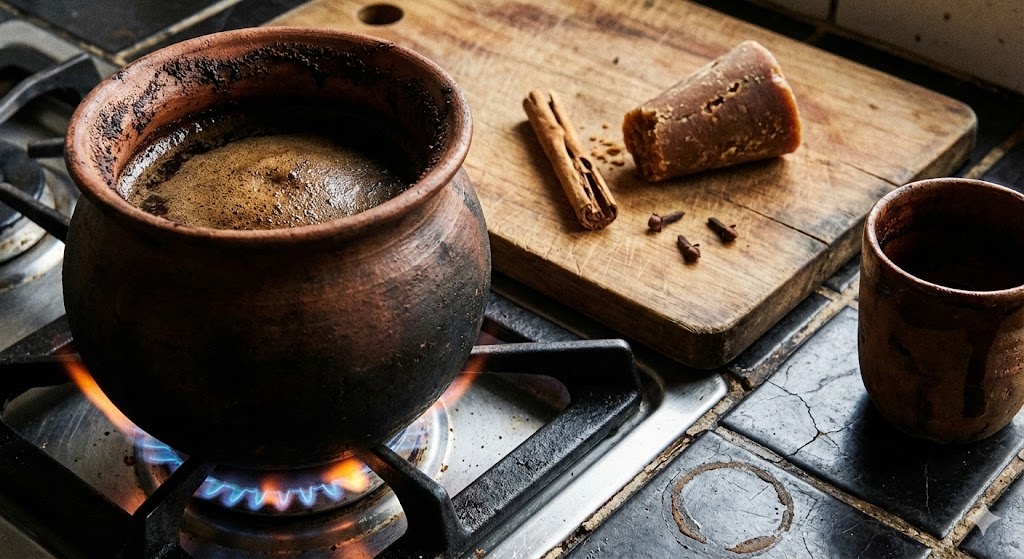
I’ve been making this wrong for two years. Not wrong like “off-ratio”—wrong like I was using a stainless saucepan and wondering why it tasted like a gas station cappuccino that had been sitting on the burner since the Eisenhower administration. The clay is load-bearing information. It leaches minerals. It creates a microenvironment. It is doing something to the extraction chemistry that I cannot fully quantify, and that ambiguity is maddening and correct.
The Mineral Situation Nobody Talks About
Before you touch the coffee, talk to your water. I’m running filtered tap here that measures around 147 ppm—not perfect, not precious. The unglazed clay olla I sourced from a ceramics market in Oaxaca (the shipping alone was an act of faith; it arrived wrapped in what appeared to be a 1987 Tiempo Libre newspaper) will contribute its own mineral signature to the brew. We are not brewing at 201°F here. We are simmering. Controlled. Somewhere between 185°F and 195°F, which means we are intentionally under-extracting by specialty standards and over-extracting by everything else’s standards, and the result is a cup with a lipid-film surface sheen that tells you the body is doing something real.
The piloncillo matters because it is not sugar. It is a compressed cone of unrefined cane with residual molasses and volatile aromatics that will participate in a low-grade Maillard reaction with the brewing coffee during the open simmer. You will not get this from turbinado. You will not get this from “dark brown sugar.” Don’t.
Recipe: Café de Olla (Serves 4, or One Long Afternoon)
What You Need
- 1 liter of water (filtered, not distilled—you need those ions)
- 85g coarsely ground dark-roast Mexican coffee (Veracruz or Chiapas; Oaxacan single-origin if you’re feeling righteous)
- 90g piloncillo, roughly broken (a hammer works; so does your frustration)
- 2 sticks Ceylon cinnamon (not Cassia—the coumarin content in Cassia at this brew volume is a problem you don’t need)
- 3 whole cloves
- 1 unglazed clay olla, pre-seasoned (if it’s new, fill it with water and let it sit for 24 hours first; ignore this and it will crack and you will deserve it)
The Process
Combine the water, piloncillo, cinnamon sticks, and cloves in the olla over medium-low flame. (My setup is a cast-iron trivet over a gas burner because my olla has a round bottom and physics is non-negotiable.) Stir occasionally with a wooden spoon—not silicone, not metal—until the piloncillo is fully dissolved. This takes longer than you want it to. The water will turn the color of weak iced tea and smell like something your grandmother would have kept in an unlabeled jar.
Bring the liquid to just below a simmer. You want movement at the surface—lazy, rolling bubbles, not a full boil. A full boil will blow out your aromatics and you’ll be left with a chalky, flat extraction that smells like a wet burlap sack.
Add the ground coffee. Do not stir aggressively. Stir once, slowly, to wet the grounds. Then let it go. You are not a French press. You are not agitating. You are letting gravity and heat do the theology.
Simmer—emphasis: simmer, not boil—for 8 to 10 minutes. The surface will develop a dark, slightly viscous foam layer. This is not a problem. This is the monoglyceride suspension doing visible work. Leave it alone.
Remove from heat. Let it sit for 4 minutes. (This is when I make the mistake of checking my phone and end up reading something enraging about cold brew “innovation.”)
Strain through a fine mesh strainer lined with cheesecloth into pre-warmed clay cups or mugs. Press gently on the grounds. You are not a wine producer. Don’t squeeze the life out of it.
Drink it immediately. Not “while it’s hot”—immediately. The clay cup continues to transfer heat in a way that is subtly different from ceramic. This is not placebo. I’ve measured it with an IR thermometer at 3 a.m. like a normal person.
What It Should Taste Like (And Why The Instant Version Can Go Straight to Hell)
The finish should be long, slightly resinous, with a sweetness that sits behind the teeth rather than on the tip of the tongue—that’s the piloncillo doing compound work with the cinnamon’s cinnamaldehyde content. There should be a ghost of clove that arrives late, like it took the bus. The body is full. Not “smooth”—full. There’s a difference. Smooth is absence. Full is presence. The sediment you’ll find at the bottom of your cup after the second sip is correct and expected and you should not send it back.
The instant “Café de Olla” packet products lining the import aisle at every grocery store between here and the 405 freeway taste like a melted crayon dissolved in brown water. There is no extraction happening. There is no Maillard anything. It is industrial sludge with cinnamon-flavored ambitions, and I won’t spend another sentence on it.
The Clay Problem You’ll Eventually Have
Your olla will crack. Maybe not the first time, maybe not the fifth. But thermal cycling on an unglazed earthenware vessel is a negotiation, not a guarantee. When mine cracked last November (I’d gotten impatient and put it on too-high heat because it was cold and I was tired and my neighbor had been playing corridos at volume since 7 a.m.), I spent three days using a stainless pot and the coffee was technically fine and spiritually wrong. I ordered a replacement from the same market in Oaxaca. I paid the shipping. It was worth it. This is the tax you pay for making things correctly.