
There is a version of this drink being served in approximately eleven thousand airport cafés right now, made with maple-flavored syrup pumped from a plastic bottle that has never been within four hundred miles of a maple tree. It is brown, it is sweet, it is an affront to the province of Quebec, and if you’ve had that version and written off the concept entirely, I understand you but you are wrong. The real thing—double espresso, actual Grade A Dark maple syrup, properly steamed whole milk—is a different negotiation entirely. It is not a dessert drink. It is not a “treat yourself” drink. It is a cold-weather utility vehicle with a surprisingly high TDS floor and a finish that lingers longer than you expect.
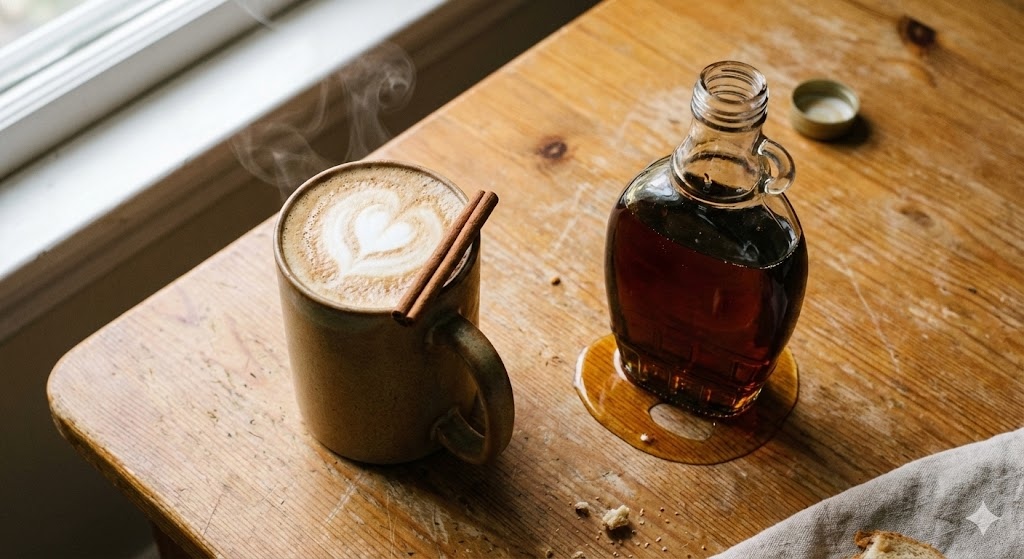
The problem is that most people making this at home are treating the maple syrup as a sweetener. It is not just a sweetener. It contains over 67 volatile aromatic compounds including vanillin, furaneol, and maple furanone—the same class of compounds that give aged spirits their complexity. When you pull a hot double ristretto directly over a measure of Grade A Dark syrup sitting at the bottom of a pre-warmed cup, those compounds hit the extraction at around 190°F and do something. Not magic. Chemistry. There is a difference and only one of them is repeatable.
The Syrup Grade Is Not A Marketing Distinction
Grade A Golden is delicate and floral and belongs in salad dressing. Grade A Amber is the one civilians buy and it is fine. Grade A Dark—sometimes still labeled “Grade B” by older producers who haven’t updated their packaging—is the one you want here. It has a more pronounced molasses-adjacent bitterness that will hold its own against a properly pulled ristretto instead of being steamrolled by it. (I buy mine from a small producer in New Brunswick whose label looks like it was designed in 1987 using clip art. I found them at a farmers market in Montreal and have been ordering by mail ever since. The Costco jug is not the same thing. I don’t care how convenient it is.)
The maple-to-espresso ratio matters more than people admit. Too little and you’re drinking a latte with a rumor of maple. Too much and the sucrose content pushes the mouthfeel into tacky territory—that coating-on-the-teeth sensation that signals you’ve crossed from beverage into syrup delivery system. Twenty milliliters of Grade A Dark per double ristretto is where I’ve landed after what my partner describes as “an unreasonable number of test batches.”
Recipe: Canadian Maple Latte (Serves 1, Obviously)
What You Need
- 18g espresso, ground for ristretto (a dark-roast single origin from Ontario’s growing specialty scene works; so does a quality Italian blend if you’re not precious about it)
- 20ml Grade A Dark maple syrup (real. Actual. From a tree.)
- 180ml whole milk, cold
- A pinch of cinnamon for finishing — not a snowdrift, a pinch
- A pre-warmed 8oz ceramic cup
The Process
Warm your cup first. Fill it with hot water from your machine’s hot water tap and let it sit while you prep everything else. A cold cup is an act of sabotage against your own drink — the thermal shock drops your extraction temperature by 8–10°F the moment it hits the ceramic and you will taste it.
Pour the maple syrup into the bottom of the now-emptied, warmed cup. Don’t stir it. Don’t spread it. Let it sit there like it owns the place.
Pull your ristretto — 18g in, targeting 25–30ml out, in 25–30 seconds — directly onto the syrup. The heat of the extraction will begin dissolving and integrating the syrup without you having to do anything. Stir once, slowly, with a small spoon. The result should smell like a forest fire in the best possible way.
Steam your milk. You want microfoam — not the stiff, chalky foam that sits on top of a cappuccino like insulation, and not flat scalded milk that’s been blasted to 160°F and smells faintly of wet cardboard. You want texture. Silky, integrated, pourable at around 140°F. (If your thermometer is broken, stick your hand on the side of the pitcher — the moment it gets uncomfortable to hold is approximately 130°F. You want a few seconds past that.)
Pour the milk over the espresso-maple base in a slow, controlled stream, holding the foam back with a spoon until the final pour, then lay it on top. You’re not a barista at a competition. You don’t need latte art. You need the foam distributed correctly so the first sip isn’t just hot milk.
Finish with the cinnamon. A pinch from shoulder height so it distributes. Not a pile in the center that turns into a wet brown clump on first contact with foam.
Drink it while it’s hot. The maple-espresso integration at the bottom of the cup is the best part and you will miss it if you let it cool into a lukewarm, vaguely sweet milk situation.
What It Should Taste Like (And What Went Wrong If It Doesn’t)
The first sip should be milk-forward with a background sweetness that isn’t simple — the maple’s vanillin compounds create a faint woodsmoke quality behind the sweetness that clean white sugar cannot replicate. The espresso should be present but not aggressive. The finish is where it pays off: a lingering, slightly bitter-sweet warmth that sits in the back of the throat and doesn’t let go for thirty seconds. That’s the dark roast and the maple furanone doing compound work and it is the entire point of the exercise.
If it tastes flat and one-dimensionally sweet, your syrup is Grade A Golden and you bought the wrong bottle. If the espresso is getting completely buried, you’ve over-poured the syrup or under-extracted the shot. If there’s a tacky, coating-the-tongue quality that won’t resolve, you’ve gone over 25ml of syrup and you need to recalibrate. If the foam is sitting on top like a separate entity and the drink feels stratified, your steaming temperature was too low and you didn’t integrate the pour correctly.
The bad commercial versions — the ones with the pump bottles, the ones at chain coffee shops where “maple latte” means brown sugar syrup with maple flavoring listed seventh on the ingredient deck — taste like a pancake dissolved in hot milk. There is no espresso character. There is no aromatic complexity. There is just sweetness in a cup with a leaf on the sleeve. I’ve paid for enough of them in airport terminals to know exactly what I’m talking about.
The Grade A Dark Problem In Your City
Finding Grade A Dark outside of Canada or the northeastern United States is a genuine logistical problem. Specialty grocery stores sometimes carry it; natural food co-ops more reliably so. (The Whole Foods near me stocks it inconsistently, which is to say it’s there when I don’t need it and gone when I do.) Online ordering from a Canadian producer is genuinely the most reliable solution and the shipping cost, while annoying, is a one-time psychic hurdle you clear and then stop thinking about. You order a liter, you use it for three months, you reorder. It becomes infrastructure. Grade A Amber is an acceptable field substitution if you increase the dose slightly to compensate for the lower aromatic intensity — go to 25ml and accept that the complexity ceiling is lower. What you should not do, under any circumstances, is buy the maple-flavored pancake syrup and convince yourself it’s close enough. It isn’t. It tastes like a candle.