
Cold brew is not iced coffee. Write that on your hand. Iced coffee is hot-brewed coffee poured over ice, which flash-chills and oxidizes and goes bitter and flat within the hour. Cold brew is a cold-water extraction that runs anywhere from 12 to 24 hours depending on your grind, your ratio, and your patience—which, if you’re making cold brew, you apparently have in abundance. The result is a concentrate with TDS readings that sit 20 to 30 percent higher than standard drip, a near-zero acidity profile, and a body so full it coats the inside of the glass. It is not “smooth.” That word is a marketing word. It is low-acid, high-body, and chemically different from anything you’re going to produce with heat.
The reason it tastes sweeter than hot coffee has nothing to do with added sugar. Heat accelerates the extraction of chlorogenic acids, which break down into quinic and caffeic acids—the compounds responsible for that sharp, metallic bitterness in over-extracted drip coffee. Cold water extracts them much more slowly, and at 12 hours you’re pulling mostly sugars, lipids, and the pleasant mid-range aromatics before the bitter compounds have time to fully dissolve. You are essentially exploiting the solubility differential between desirable and undesirable compounds. This is chemistry. This is also why leaving it at 24 hours starts to push into over-extraction territory even in cold water, and why the cold brew concentrate that’s been oxidizing in your fridge for 12 hours already smells like a wet sock and you should pour it out.
The Grind Is Not Negotiable
Coarse. Not medium-coarse. Not “pretty coarse.” The grind setting you use when you’ve gone too far and think you’ve ruined it—that coarse. We are talking roughly the texture of raw turbinado sugar, maybe coarser. Fine or medium grinds in a cold brew dramatically increase the surface area in contact with water over 12-plus hours, and the over-extraction you get is aggressive and irreversible. (I learned this the expensive way using a $40 bag of single-origin Ethiopian that came out tasting like a nickel dissolved in chocolate milk. The grief was real.) A burr grinder is not optional if you care about consistency—blade grinders produce a particle size distribution so chaotic that you’re essentially brewing three different coffees at once.
For beans: medium-to-dark roasts perform best here. The Maillard reaction and caramelization compounds developed in darker roasts are highly soluble in cold water and produce the chocolate, nutty, low-acid profile cold brew is known for. Light roasts—particularly the high-altitude, washed-process East African stuff with its bright fruit and floral notes—lose most of their character in cold extraction. Those beans want heat and precision, not a mason jar in the back of your refrigerator.
Recipe: American Cold Brew Concentrate (Makes ~1 liter concentrate)
What You Need
- 120g coarsely ground medium-dark roast coffee
- 600ml cold filtered water (not distilled — you want minerals in the 75–150 ppm range)
- A large mason jar or pitcher (at least 1 liter capacity)
- Fine mesh strainer plus cheesecloth, or a dedicated cold brew filter
- A second clean jar for the finished concentrate
- 12 to 18 hours and the ability to leave things alone
The Process
Combine the coarsely ground coffee and cold water in your jar. Stir once — just enough to make sure all the grounds are wet. You are not making a cocktail. You are not shaking it. One stir, done. (I use a chopstick. I don’t know why. It has become ritual at this point.)
Cover the jar loosely — not airtight, the grounds need to off-gas — and place it in the refrigerator. Cold-fridge extraction at around 38°F is what we’re doing here, which is slower and cleaner than counter-top cold brew at room temperature. Counter-top extraction runs faster but also ferments faster, and the line between “interesting funky complexity” and “something has gone wrong” is thinner than you want it to be on a warm day.
Leave it for 12 hours minimum. 14 to 16 hours is the sweet spot for most medium-dark roasts at this ratio. Do not open the fridge and stir it. Do not check on it. It is brewing. You have other problems.
After your steep time, set your fine mesh strainer lined with two layers of cheesecloth over the second clean jar. Pour slowly. Do not squeeze or press the grounds through the cheesecloth — that forces fine particles and bitter lipids through the filter and clouds the concentrate with chalky sediment you don’t want. Gravity is doing the work. Let it drip. This takes 10 to 15 minutes and feels excessive and is not excessive.
What you have now is concentrate. It is not ready to drink straight — or it is, if you want to feel your heartbeat in your eyeballs. The standard dilution ratio is 1:1 with cold water or milk over ice. Adjust from there based on how you’re built.
What It Should Look Like and Taste Like
Properly made cold brew concentrate is dark, deeply brown — not black — with a faint viscosity that coats the inside of the glass. Held up to light it has a reddish-brown transparency, not opacity. If it’s opaque and chalky, your grind was too fine or you squeezed the filter. If there’s a visible lipid-film on the surface after dilution, that’s not a problem — that’s the suspended coffee oils doing their job and you should leave them alone.
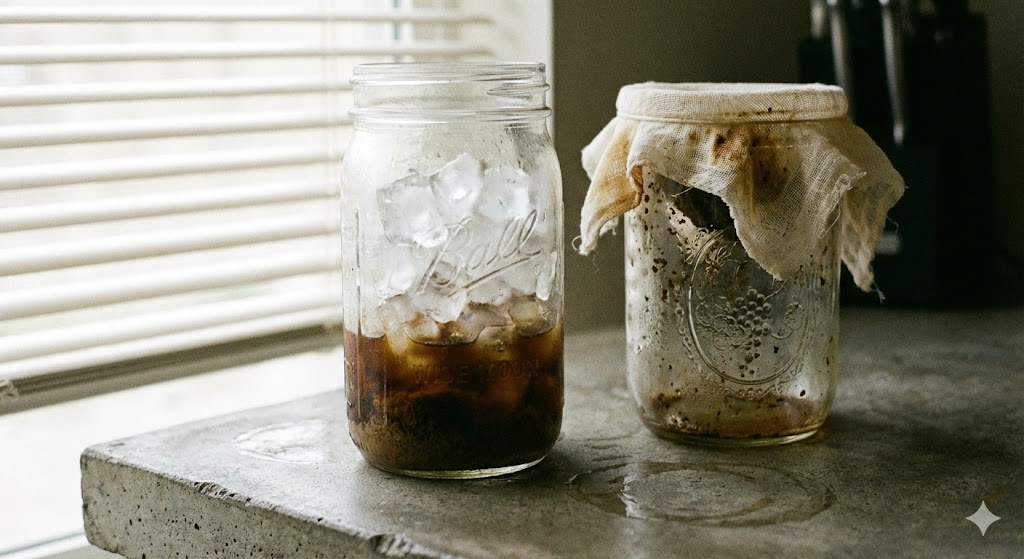
The taste should open with low, sweet chocolate or caramel depending on your bean, settle into a mild nuttiness in the mid-palate, and finish long and clean with almost no bitter aftertaste. If it’s bitter, you steeped too long or ground too fine. If it’s thin and watery with no body, your ratio was off or your grind was too coarse and you under-extracted. Nail the grind and the ratio and this is one of the most forgiving brewing methods there is.
The Concentrate Will Not Last Forever — A Warning
Cold brew concentrate keeps in a sealed jar in the refrigerator for up to two weeks before oxidation starts degrading it noticeably. After that it doesn’t become dangerous, it just becomes disappointing — flat, slightly stale, with a faint metallic edge that no amount of ice is going to fix. Label the jar with the date you made it. You will not remember. Nobody ever remembers. Two weeks, sealed, refrigerated. That’s your window.