
Frothing jugs are designed with specific spout shapes and volumes to help create consistent microfoam.
How milk frothing jugs actually work has gotten more complicated than it needs to be with all the barista jargon and brand-specific marketing flying around. As someone who has used several different jug styles and spent time learning why the design choices matter, I learned everything there is to know about what actually affects your frothing results. Today, I’ll break down what you need to know before buying one.
A Handheld Milk Frothing Jug
A handheld milk frothing jug has a base vessel into which you pour steamed milk, then use an electric or manual whisk to create foam directly in the jug. Some versions come with both a wand for frothing and a separate bowl for heating — the heating and frothing steps happen sequentially rather than simultaneously.
These are convenient for occasional home use and take up minimal counter space. The trade-offs in my experience: cleanup is more involved than countertop models because of the wand mechanism, and you need to replace wands periodically as they wear out. They also require a bit more technique — you’re controlling the frothing motion manually rather than relying on the machine to do it consistently.
Countertop Milk Frothing Jug
The countertop model is what professional baristas prefer. It’s larger, designed to sit on the counter permanently, and typically includes a thermostat to monitor and control temperature. The better countertop models have two components: the base unit stays in place while a separate frothing jug holds the milk, allowing you to heat and froth simultaneously rather than in sequence.
That simultaneous heating and frothing is the key advantage. It saves time and produces more consistent results because you’re not losing temperature between the heating and frothing steps. For anyone making lattes or cappuccinos daily, the countertop model is worth the additional cost and counter space.
Common Jug Materials
The material affects heat transfer, durability, and how well you can feel what’s happening during frothing. Three main options:
Stainless steel is the industry standard for a reason. It’s durable, easy to clean, and conducts heat in a way that helps you monitor milk temperature by feel — experienced baristas can gauge when milk is at steaming temperature by how warm the jug feels in their hand. The downside is weight and the fact that it can get cold in a draughty kitchen, which affects temperature consistency.
Glass is durable as long as you don’t drop it, and it’s dishwasher-safe on most models. Some glass jugs can get uncomfortably hot to hold, which is a real usability issue when you’re trying to control a pour.
Plastic is light and typically dishwasher-safe, but doesn’t conduct heat the way steel does, which makes it harder to gauge milk temperature by touch. If you clean plastic jugs thoroughly after each use, they’re perfectly serviceable. They just look and feel cheaper, which matters if aesthetics are part of why you bought the setup.
Some models include lids, built-in thermostats, and handle grips — these additions are useful rather than cosmetic and worth prioritizing.
What’s The Best Type of Jug for Latte Art?
Probably should have led with this, honestly: if you want to make latte art, the spout shape matters more than any other single feature. A narrow, sharp-angled spout gives you the control needed for precise pours — the kind that produce hearts, rosettas, and tulips rather than blobs. A wide or rounded spout makes it much harder to direct the milk stream where you want it.
For beginners learning latte art, countertop frothing jugs are the better choice. You can focus on controlling the cup and the pour without also having to manage a handheld frothing motion. Countertop jugs are also typically larger, which gives you more room to work with the milk texture before pouring.
Handheld versions work well for experienced home baristas who have the technique down and want something more portable or compact. They’re genuinely good for skilled users — just harder to learn with.
What Size Of Milk Frothing Jug Is Best?
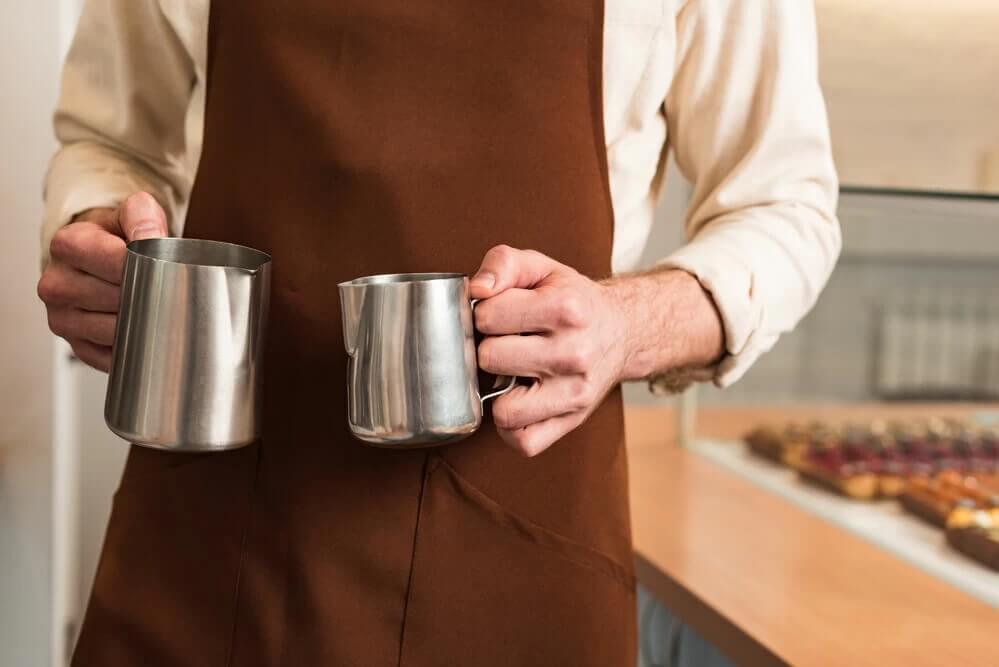
Size is primarily a function of how many drinks you make at once and how much counter space you have. For a single latte, a 300-350ml jug is the right size — you’ll fill it to about one-third with milk, leaving room for the foam to expand without overflowing. For multiple drinks, larger jugs (500-600ml) let you froth enough milk for two or three drinks at once.
Most people with countertop latte art equipment store it in a drawer when not in use to preserve counter space, but this adds a few seconds to setup each time. For daily use, keeping the jug out and accessible is more practical. Pick the size that matches how many drinks you typically make in a session and how much of your counter you’re willing to dedicate to it.
That’s what makes choosing the right frothing jug endearing to home baristas — the decision tree is simpler than it looks. Do you make one drink or several? Do you want portability or consistency? Do you prioritize learning latte art or just getting good foam quickly? Those three questions point you to the right jug more reliably than any technical specification.
Many espresso machines include a basic jug, and those starters are fine for learning. Once you know what you want from your setup, upgrading to a better quality steel jug with a proper spout makes a real difference in what you can achieve.
Milk Frothing Guides
The Bottom Line
Milk frothing jugs work by providing the right vessel shape, spout design, and material properties to help you consistently create microfoam — the fine, silky-textured frothed milk that characterizes good espresso drinks. The spout shape determines your control over pouring. The size determines how many drinks you can make per session. The material affects how well you can monitor temperature and how durable the jug is over time.
For most home baristas, a 350ml stainless steel jug with a narrow, angled spout is the right starting point. It covers a single latte or cappuccino, gives you the feedback you need to improve your frothing technique, and lasts long enough that the investment is worth it.