
I had this moment last summer that still bugs me. I was at a drive-through, running late, kids in the back seat arguing about something, and I ordered an iced coffee. Got to the window, took a sip, and thought: this tastes nothing like the cold brew I make at home on Sundays. Obviously.
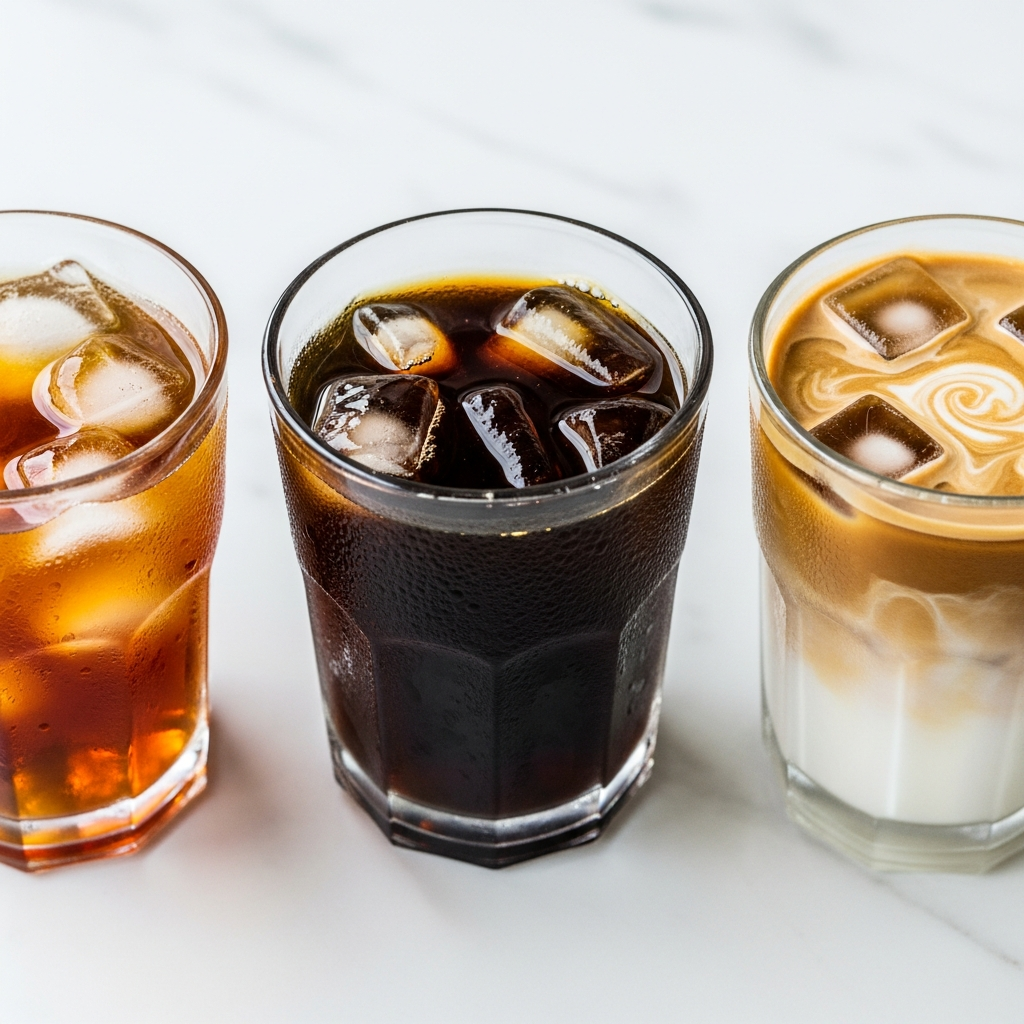
But here’s the embarrassing part. I couldn’t have told you WHY they tasted different. Not really. I’d been ordering iced coffee, cold brew, and iced lattes interchangeably for years — just picking whichever name popped into my head at the counter — without actually understanding that they’re completely different drinks. Different brewing methods, different flavor profiles, wildly different caffeine content. I felt like an idiot when I finally sat down and figured this out.
So I did what I always do when I feel dumb about something. I went way overboard. Bought the same bag of medium-roast Colombian beans and made all three at home, side by side, same afternoon. Tasted them back to back. Took notes. (Yes, I took notes on coffee. My wife walked through the kitchen, saw my little notebook, shook her head, and kept walking.) The differences were bigger than I expected, and not just in taste — cost per cup, caffeine, how long they take, what equipment you need. All different.
This is the comparison I wish someone had given me three years ago, minus the jargon and with actual opinions instead of just textbook definitions.
This article includes affiliate links. We may earn a commission at no extra cost to you.
The Quick Answer
Before we go deep, here’s the short version for people in a hurry:
- Iced coffee is regular hot-brewed coffee poured over ice. Tastes bright and acidic. Ready in 5 minutes.
- Cold brew is coffee steeped in cold water for 12-18 hours. Tastes smooth and chocolatey. Requires planning ahead.
- Iced latte is espresso (or strong coffee) mixed with cold milk over ice. Tastes creamy and mild. Ready in 3 minutes if you’ve got espresso.
Now let me explain why those differences actually matter when you’re deciding what to make.
How Each One Is Made
Iced Coffee: Hot Brew + Ice
Iced coffee starts as regular hot-brewed coffee. You brew it with hot water using whatever method you normally use — drip machine, pour-over, French press, Keurig — and then pour it over a glass full of ice.
Here’s the detail most people miss: you need to brew it stronger than normal. The ice melts and dilutes the coffee, so if you brew at regular strength, your iced coffee ends up tasting weak and watery. I use double strength — roughly 2 tablespoons of ground coffee per 6 oz of water. Took me an embarrassing number of sad, watery glasses before I figured that out.
The hot water extracts a full range of flavor compounds, including the bright, acidic ones that give coffee its complexity. When you rapidly cool it over ice, those flavors get locked in. The result is a coffee that tastes lively and dynamic — way more so than cold brew.
Active time: 5 minutes
Total time: 5 minutes
Equipment needed: Any coffee maker + ice
Cold Brew: Cold Water + Time
Cold brew is a completely different animal. No hot water involved at any point. You combine coarsely ground coffee with cold water, let it sit in the fridge for 12-18 hours, and strain out the grounds.
Because cold water extracts differently than hot, the flavor profile is night and day. Cold water doesn’t pull out the same acidic compounds. What you get instead is remarkably smooth, naturally sweet, almost chocolatey — with very little bitterness. Kind of a revelation the first time you taste it. I remember my first batch and genuinely being confused that I hadn’t added sugar.
Most cold brew is made as a concentrate (1:5 coffee-to-water ratio) and then diluted with water or milk before drinking. That makes it versatile — you can dial the strength wherever you like — but it also means you need to plan ahead. You can’t just decide at 7 AM that you want cold brew and have it ready. Tomorrow morning drink, not a right now drink.
Active time: 10 minutes (5 to set up, 5 to strain the next day)
Total time: 12-18 hours
Equipment needed: A jar + a strainer
Iced Latte: Espresso + Milk + Ice
An iced latte is the simplest concept but requires one specific thing: espresso (or a very strong, concentrated coffee). Pull 1-2 shots of espresso, pour them over a tall glass of ice, and fill the rest with cold milk.
Milk is the dominant ingredient here — an iced latte is roughly 70% milk, 20% ice, and 10% coffee. That’s why it tastes the mildest of the three. The espresso provides caffeine and a backdrop of coffee flavor, but the milk is really doing most of the heavy lifting taste-wise.
You don’t technically need an espresso machine, by the way. A Moka pot, AeroPress, or even a Keurig on the smallest cup setting produces coffee that’s concentrated enough. The key is concentration — you need 2-3 oz of very strong coffee, not 8 oz of regular stuff.
Active time: 3 minutes
Total time: 3 minutes
Equipment needed: Espresso machine, Moka pot, or AeroPress + milk + ice
Taste Comparison: What Each One Actually Tastes Like
This is the part most comparison articles gloss over — they’ll give you definitions but won’t tell you what actually happens when you take a sip. So I made all three back to back, same medium-roast Colombian beans, same afternoon. Here’s what jumped out.
Iced Coffee Taste
Bright, crisp, lively. The first thing you notice is the acidity — not in a sour or unpleasant way, but the way a fresh apple is acidic compared to applesauce. There are fruit and citrus notes you can actually pick out. The finish is clean with a slight bitterness that lingers just a few seconds.
Iced coffee has what I’d call “transparency” — you can taste the specific character of the beans. A Kenyan tastes different from a Brazilian, and those differences come through clearly. If you geek out over single-origin coffees, iced coffee (especially Japanese-style pour-over) is your best bet for preserving those nuances.
The downside: it can taste harsh if you’re sensitive to acidity. If regular hot coffee gives you an upset stomach, iced coffee will too — same acid profile.
Cold Brew Taste
Smooth, sweet, chocolatey. The first sip is a total contrast to iced coffee — no acidic bite, no brightness, just this deep, rounded sweetness that coats your mouth. The dominant flavors are chocolate, caramel, toasted nuts. It almost tastes sweetened even when it’s black — that natural sweetness is just a hallmark of the cold extraction process.
Cold brew has what I’d call “weight” — it feels heavier and more full-bodied in your mouth than iced coffee, even at the same dilution. It’s comforting in a way iced coffee isn’t. Think crisp white wine versus a smooth red. Both wine, but the experience is fundamentally different.
The downside: cold brew can taste kind of one-dimensional if you’re used to complex specialty coffee. Those fruity, floral notes that make single-origin beans interesting? Cold brew mutes them. Everything trends toward chocolate and caramel regardless of what beans you use. Not a dealbreaker for most people — but worth knowing.
Iced Latte Taste
Creamy, mild, comforting. Milk is the star — you taste creaminess first, with espresso providing a warm, roasty backbone underneath. Here’s the thing — it’s the least “coffee-forward” of the three, which is exactly why it’s the most popular. Most people who say they love iced coffee actually love iced lattes. They like coffee flavor wrapped in creamy, cold milk.
The espresso adds a roasty intensity that neither iced coffee nor cold brew can match. Because espresso is extracted under pressure, it pulls out oils and compounds other methods don’t, giving the drink a richness even in small amounts.
The downside: if you want to actually taste the coffee, an iced latte can feel like coffee-flavored milk. For me, that’s a feature or a bug depending on the day. Some mornings I want bold coffee. Other mornings I just want something cold, creamy, and lightly caffeinated — and I’m not going to apologize for it.
Caffeine Content Comparison
OK so this is where things get interesting, because the conventional wisdom (“cold brew has more caffeine”) is both true and misleading.
Cold brew concentrate has the most caffeine per ounce — roughly 200mg per 8 oz of undiluted concentrate, depending on ratio and beans. But you’re not supposed to drink it straight. (I did once. Vibrated for three hours. Don’t recommend.) Dilute it 1:1 with water and you’re looking at about 100mg per 8 oz of finished drink.
Iced coffee has roughly 95-120mg per 8 oz when brewed at double strength. Most people drink a 16 oz glass, so that’s about 190-240mg total per serving.
An iced latte with 2 shots of espresso has about 126-150mg of caffeine regardless of glass size, because the caffeine comes from the espresso, not the milk. More milk doesn’t change the caffeine — it just dilutes the flavor.
Bottom line: A 16 oz glass of properly brewed iced coffee typically packs the most caffeine, followed closely by diluted cold brew concentrate, then iced latte. But the differences aren’t massive — we’re talking maybe a 20-30% spread. If you’re choosing purely on caffeine, strong iced coffee gives you the biggest kick.
Cost Per Cup
I tracked the cost of all three using the same $14/lb bag of medium-roast from my local roaster:
Iced coffee: About $0.35 per 16 oz glass. You use 2 tablespoons of coffee (roughly 14g), some hot water, and ice. Cheapest option by far.
Cold brew: About $0.55 per 16 oz glass (after dilution). Cold brew uses more coffee per serving — the 1:5 concentrate ratio requires about 20g of coffee per finished 16 oz glass once diluted. That higher coffee-to-water ratio adds up.
Iced latte: About $0.70 per 16 oz glass. The espresso itself is about $0.25, but you also need 10-12 oz of milk, which adds $0.40-0.45 depending on the milk. Oat milk or other specialty milks? That number goes up fast.
For comparison: The same drinks at Starbucks cost $3.45 (iced coffee), $4.25 (cold brew), and $5.75 (iced latte) for a grande. Making them at home saves roughly $3-5 per drink. If you drink one a day, that’s $90-150/month you’re keeping in your pocket. Do the math on that over a year and… yeah.
Time to Make
If your mornings are rushed (and whose aren’t), this matters:
Iced latte wins the speed race — 3 minutes from start to sipping if your espresso machine or Moka pot is already warmed up. Pull shots, pour over ice, add milk, done.
Iced coffee takes about 5 minutes — brew time for the hot coffee plus a minute for it to melt the ice and cool down. Pre-brew and fridge it overnight though? 30 seconds. Just pour over ice.
Cold brew takes 12-18 hours of passive steeping, but the actual hands-on work is only about 10 minutes total (5 to set up, 5 to strain next day). Once you’ve got a batch in the fridge, serving takes 30 seconds — just pour and go. The trick with cold brew is batch-prepping. Make a big batch Sunday and you’ve got cold brew ready every morning all week.
Equipment Needed
This is often the deciding factor for beginners:
Iced coffee: Whatever coffee maker you already own + ice. Zero extra equipment. Drip machine, pour-over, French press, Keurig, even instant coffee. Most accessible option by a mile.
Cold brew: A jar (any glass jar or pitcher works), a strainer, and optionally some cheesecloth. Total cost for dedicated equipment: $0-10. You don’t even need a coffee maker — it’s just immersion brewing.
Iced latte: Something that makes espresso or approximates it. An espresso machine ($100-1000), Moka pot ($25-40), AeroPress ($35), or a Nespresso machine ($150-250). Plus milk. This is the most equipment-dependent method.
Which Should YOU Make? A Decision Tree
Look — I’ve boiled all of this down to a few simple questions. Answer them and you’ll land on the right drink:
Question 1: Do you like the taste of coffee, or do you prefer it masked by milk and sweetness?
- If you like bold coffee flavor: continue to Question 2.
- If you prefer it mild and creamy: make an iced latte. The milk softens everything and makes it super approachable.
Question 2: Do you have 12+ hours to plan ahead?
- Yes, I can prep the night before: make cold brew. Smoothest, least acidic option. Once you’ve got a batch ready, serving takes 30 seconds.
- No, I need coffee now: continue to Question 3.
Question 3: Do you have a sensitive stomach or dislike acidic coffee?
- Yes: go back and make cold brew when you can. In the meantime, make iced coffee with a dark roast (lower acidity) and add milk to buffer it.
- No: make iced coffee. Fast, cheap, and the most interesting flavor complexity of the three.
Question 4 (wildcard): Do you own an espresso machine?
- Yes: make iced lattes on weekdays (fast, easy) and cold brew on weekends (smooth, relaxing). That’s my rotation and it works great.
- No: stick with iced coffee for daily drinking and batch cold brew for weekend sipping.
Can You Mix Methods?
Absolutely. And honestly, I’d encourage it. Here are some combos that work really well:
- Cold brew concentrate as a latte base. Use cold brew concentrate instead of espresso in an iced latte. Pour 3 oz of 1:5 concentrate over ice, add milk. Smoother than espresso-based and you don’t need a machine.
- Iced coffee with cold brew cubes. Brew iced coffee normally but use frozen cold brew cubes instead of regular ice. As the cubes melt, your drink gets stronger instead of weaker. Absolute game-changer.
- Iced latte with flavored cold brew. Make a batch of vanilla or cinnamon cold brew (add vanilla extract or cinnamon sticks during steeping), then use it as the coffee base for a flavored iced latte. For more flavored coffee ideas, check out my caramel iced coffee guide.
What About Nitro Cold Brew?
Nitro cold brew has gotten hugely popular over the last few years, so it’s worth addressing. Nitro is just regular cold brew infused with nitrogen gas through a pressurized tap — same idea as how Guinness gets its creamy head.
The nitrogen adds a creamy, cascading texture and velvety mouthfeel that makes cold brew taste like it has cream in it, even when it’s completely black. It’s delicious. But making real nitro at home requires specialized equipment (a nitrogen gas cartridge and a whipped cream dispenser at minimum, or a dedicated nitro cold brew maker for $50-100).
Want the nitro experience without the gear? The closest hack is to cold brew normally and then froth it with a handheld milk frother for 15-20 seconds before serving. It won’t give you the exact cascading effect, but it adds a similar creamy, airy texture that’s honestly pretty good.
Frequently Asked Questions
Is cold brew healthier than iced coffee?
Honestly? Basically the same nutritionally when you drink them black. Cold brew is lower in acid, which helps some people’s stomachs. But the real health impact comes from what you dump into the cup — cream, sugar, flavored syrups. That matters way more than the brewing method ever will.
Why is cold brew more expensive at coffee shops?
Two reasons: uses more coffee grounds per serving, and ties up equipment and fridge space for 12-18 hours. Higher input cost plus longer production time equals that $0.50-1.00 markup. Makes sense from their side, honestly.
Can I order an “iced coffee” at Starbucks and get cold brew?
Nope. Totally separate menu items. They taste very different, so always specify. I learned this the hard way at a drive-through. Awkward.
Which tastes best with milk?
Iced latte wins by default since it was literally built for milk. But for just a splash? Cold brew blends way more smoothly than iced coffee. The higher acidity in iced coffee can taste a touch harsh or even slightly curdled with milk — that’s the acid reacting. I’ve got a guide on making a carajillo if you want to try coffee paired with something other than milk entirely.
Can I use decaf beans for all three methods?
Yep, all three work fine. Flavors will be slightly muted (decaffeination strips some compounds along for the ride), but the basic profiles hold. Decaf iced coffee still bright. Decaf cold brew still smooth. No drama.
What about iced Americano? Where does that fit?
It’s espresso diluted with cold water over ice — basically the middle ground between iced coffee and an iced latte. Espresso flavor without the milk. Taste-wise, closer to iced coffee but with that roasty depth only espresso pulls off. Worth trying if iced lattes feel too milky for you.
My Personal Recommendation
After making all three methods more times than I can count, here’s what I actually do: I keep a batch of cold brew concentrate in the fridge at all times (fresh batch every Sunday, it’s become a little ritual). Weekday mornings when I want something simple, I pour it over ice with a splash of oat milk — 30 seconds, out the door. Weekends when I feel like making something more indulgent, I pull espresso shots for a proper iced vanilla latte.
I rarely make traditional iced coffee anymore — not because it’s bad, but because cold brew batch-prepping is just so much more convenient for the daily grind. (Sorry.) That said, when I’ve got good single-origin beans and want to taste them at their best? Japanese iced pour-over with a Chemex. Every time. The brightness and complexity of that method is genuinely unmatched.
Honestly, the best method is whichever one fits your routine and your taste preferences. Try all three, find your rhythm, and go with what makes you excited to drink coffee every morning. That’s the whole point.