
In a stunning turn of events that has sent shockwaves through Washington DC’s coffee community, Compass Coffee filed for Chapter 11 bankruptcy reorganization on Tuesday, marking a precipitous fall for what was once celebrated as a local success story.
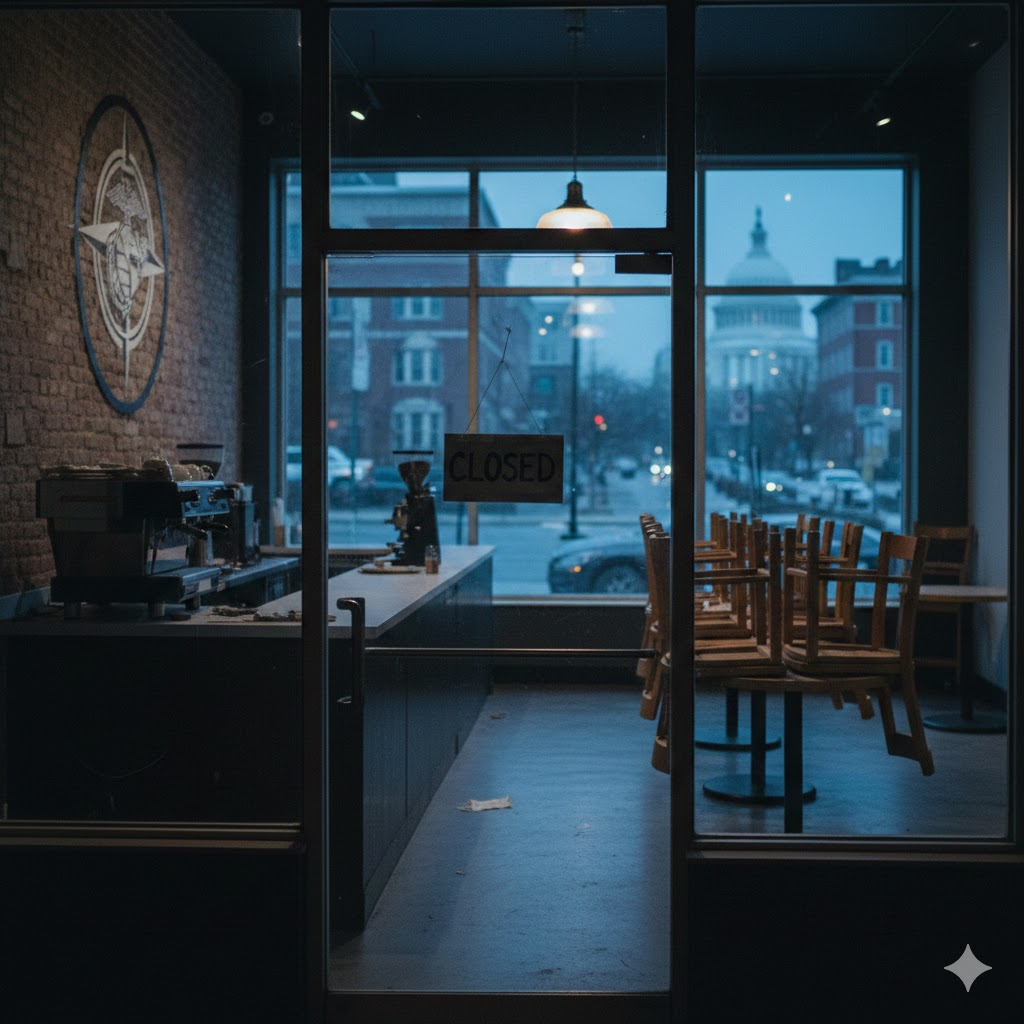
The veteran-owned coffee roaster, founded by two Marines in 2014, announced plans to close 11 of its more than 20 cafes across the Washington, DC metro area amid mounting debt, landlord lawsuits, and internal turmoil that includes a bitter legal battle between its co-founders.
A Story That Started With Promise
Compass Coffee began as the kind of feel-good narrative that DC loves—two former Marine Infantry Officers, Michael Haft and Harrison Suarez, who after years of drinking terrible coffee on deployment in Afghanistan, returned home with a mission to create “Real Good Coffee.”
They opened their first location in September 2014 in a converted laundromat in DC’s Shaw neighborhood, combining a café with a small-batch roastery. The company grew rapidly, expanding from one location to 25 across Washington, DC, Virginia, and Maryland over the course of a decade.
By 2017, then-DC Mayor Muriel Bowser featured Compass Coffee in her State of the District Address, praising the company for “jump-starting the Made in DC movement and creating jobs.” Founder Michael Haft received the DC Chamber of Commerce’s Community Impact Award that same year.
The company built partnerships with organizations like Dog Tag Bakery, which teaches entrepreneurship to disabled veterans and their caregivers. They collaborated with The Washington Post on a branded coffee blend. They opened their first drive-through location. Everything seemed to be heading in the right direction.
Then came 2020.
The Pandemic Pivot That Didn’t Save Them
The COVID-19 pandemic devastated Compass Coffee’s customer-facing retail business. According to CEO Michael Haft’s bankruptcy filing, the company laid off 150 of its 189 employees in March 2020. The remaining 39 staff members had their pay slashed to $15 per hour, with 20 of them tasked with constructing a new roasting facility.
In a controversial move that angered workers, Compass eliminated credit card tipping options—directly cutting into employee wages at a time when they needed it most.
The company did receive over $9.9 million in government pandemic assistance and attempted to pivot by developing a coffee roastery and distribution business to offset the loss of café traffic.
But as Haft noted in his filing, even after the pandemic ended, customer traffic “continued to depress due to forces beyond the company’s control”—including reduced federal government employees in DC offices and the permanent shift to remote work for many regional businesses.
“While some café locations remain profitable, others are only minimally profitable or unprofitable,” Haft wrote.
The Numbers Don’t Lie
The bankruptcy filing reveals the extent of Compass Coffee’s financial troubles:
Secured Debt:
- EagleBank: $643,779.25 (term loan)
- Small Business Administration: $464,782.07 (pandemic disaster assistance)
- Square: $518,083.19 (receivables financing)
- Four creditors with liens: approximately $1.7 million
Unsecured Debt:
- Over 100 unsecured creditors owed approximately $4.8 million
- These debts are primarily past-due rent, unpaid purchase amounts, and accounts payable to suppliers
- Approximately $5.2 million owed to insider and outside investors
- About $100,000 in credits to inKind
The company currently employs 166 individuals across its corporate headquarters and 25 cafés.
The Bitter Co-Founder Battle
Adding another layer of complexity to the bankruptcy is a nasty lawsuit between the two co-founders. On January 13, 2025—less than a month before the bankruptcy filing—Harrison Suarez sued Michael Haft, accusing him and the Haft family of “running a racketeering enterprise.”
According to The Washington Post, Suarez claimed he was terminated by Haft via email in mid-2021 and was never paid the fair market value of his ownership stake as outlined in their operating agreement. Suarez is seeking millions in compensation.
The lawsuit threatens to “puncture the company’s reputation as a feel-good story of two former Marines who built a coffee franchise from the ground up,” as the Post reported.
The timing is particularly damaging—trying to reorganize a business while the co-founders are locked in litigation over fraud and racketeering allegations doesn’t inspire confidence in potential buyers or creditors.
A Strategic Buyer on the Horizon?
Despite the dire circumstances, Haft indicated in his bankruptcy filing that the company has completed negotiations with a “strategic buyer with a substantial, global presence in the retail coffee business.”
“The proposed sale is contemplated to be a sale of assets of the business as a going concern, free and clear of claims, except those expressly assumed,” Haft wrote. “Compass expects through the sale to pay its secured lenders in full, to pay the restructuring costs incurred to conduct the chapter 11 sale process, and to have additional proceeds sufficient to make a distribution to unsecured creditors.”
The company has been actively marketing itself for sale since May 2021, with multiple suitors expressing interest in acquiring either the entire company or significant portions of it.
Whether any buyer will follow through now—with 11 locations closing, co-founders suing each other, and millions in debt—remains to be seen.
Industry Context: Coffee Chains Under Pressure
Compass Coffee isn’t alone in its struggles. The bankruptcy filing comes amid broader challenges facing the coffee industry:
- Rising Coffee Prices: According to the Labor Department, coffee prices are up 19% over the past year, significantly outpacing inflation
- Climate Impact: Adverse weather has hurt crop yields in major producers like Vietnam and Brazil
- Tariff Pressures: New tariffs on coffee-producing nations have raised costs for importers
- Consumer Behavior: Cash-strapped consumers are becoming more selective about discretionary spending
Even Starbucks is closing 434 locations as part of a $1 billion restructuring plan. Other regional chains like The Blend Coffee and Cocktails in Florida and Cuppa Austin in Texas have also filed for bankruptcy in recent months.
What Happens Next
The Chapter 11 bankruptcy filing provides Compass Coffee with protection from creditors while it attempts to reorganize—or more likely, complete a sale to the mystery buyer.
The 11 underperforming locations will close, though the company hasn’t specified which cafés will shutter. For now, the remaining 14 locations continue to operate.
Haft has filed a motion for an automatic stay in the civil lawsuit with Suarez, and both parties are required to submit a joint status report within seven days addressing how the bankruptcy affects the ongoing litigation.
For Washington DC’s coffee community, it’s a sobering reminder that even the most beloved local brands—built on compelling narratives and community goodwill—aren’t immune to the brutal economics of retail operations, especially in a post-pandemic world where consumer habits have permanently shifted.
The Bigger Picture
The collapse of Compass Coffee serves as a cautionary tale for specialty coffee roasters everywhere. Success requires more than great coffee and a compelling origin story—it demands:
- Sustainable lease agreements that can weather economic downturns
- Diversified revenue streams beyond brick-and-mortar retail
- Healthy working relationships between founders
- Conservative debt management
- The ability to adapt quickly to fundamental shifts in consumer behavior
The Marine Infantry Officers who once bonded over terrible coffee in Afghanistan and dreamed of bringing “Real Good Coffee” to their hometown now find themselves on opposite sides of a legal battle, with their shared creation hanging in the balance.
Whether Compass Coffee emerges from bankruptcy as a going concern under new ownership, or becomes another cautionary tale in the annals of specialty coffee, one thing is certain: the veteran-owned feel-good story has taken a decidedly darker turn.
References:
- Washington Post. (2026). “Compass Coffee files for bankruptcy amid lagging sales, lawsuits.”
- Patch. (2026). “Compass Coffee Files For Chapter 11 Bankruptcy.”
- Washington Post. (2025). “Compass Coffee founders split amid covid fraud, racketeering claims.”
- TheStreet. (2025). “Starbucks rival closes key location as bankruptcy looms.”
- Newsweek. (2025). “Multiple coffee chains file for bankruptcy across US.”